The biggest problem with bioenergetic scanning isn’t whether the machine works. It’s that nobody will give you a straight answer about it.
Half the internet says it changed someone’s life. The other half calls it total rubbish. And you’re sitting there with fifteen browser tabs open at 10pm, trying to work out which camp is telling the truth, while your partner has already decided it’s a waste of money.
Here’s what I’ve found after 30 years of clinical practice and training on this technology alongside psychiatrists, nutritionists and biohackers who all read the same scan data completely differently. The scan measures something physically real. It picks up changes in your skin’s electrical conductance, the same biofeedback signal used in polygraph machines and heart rate variability monitors that mainstream science accepts without argument.
The UK’s advertising regulator has explicitly stated they’ve “yet to see any evidence” that these devices can diagnose disease. Both of those things are true at the same time.
The measurement is real. The diagnostic claims are unproven. And the variable that actually determines whether your scan produces anything useful isn’t the machine. It isn’t the science. It’s the person reading your results.
I should be straight with you before we go any further. I use a Qest4 scanner in my clinic at Rise Radiantly, so I’ve got a stake in this conversation. I’ve tried to write the most honest assessment I can, including the parts that don’t look great for my profession. You deserve the full picture before anyone asks for your money.
Here’s where the evidence actually lands.
Key Takeaways
- Bioenergetic scanning measures a real physiological signal, but no clinical trials have validated its use as a diagnostic tool
- The same machine produces completely different insights depending on who reads the data. The practitioner is the variable nobody discusses
- If a practitioner implies the scan provides a medical diagnosis, that’s a red flag. UK regulators have explicitly said the evidence isn’t there
- UK scan prices range from £30 to over £500. The gap is almost entirely about the practitioner’s depth, not the machine
Here for a specific concern?
- Wondering whether the scan actually measures something real? Start with what the scan picks up.
- Want the honest picture on scientific evidence? Read the research section.
- Trying to figure out whether those disclaimers are just small print or something serious? See what the disclaimers mean.
- Not sure if bioenergetic scanning is even right for your situation? Check the fit section.
What does a bioenergetic scan actually measure?
It picks up tiny electrical changes on your skin. When your body responds to something, your sweat glands activate and the conductance shifts. Scientists call this galvanic skin response. It’s controlled by your sympathetic nervous system, the part that handles “fight or flight.”
That measurement is physically real, peer-reviewed and used in mainstream science for studying emotion, attention and stress. Nobody argues about whether the signal itself exists.
But here’s where I need to be honest. The signal is what scientists call “non-specific.” It tells you that your body is responding. It can’t tell you why.
The same shift could be triggered by an emotional reaction, a temperature change or a problem you haven’t identified yet. Your skin doesn’t label its signals with helpful notes.
Think of it like a thermometer. If it reads 38°C, the measurement is accurate. But whether that means you’ve got an infection, you’ve just finished a run or you’re fighting the flu requires a person who knows what questions to ask.
The scan sends hundreds of frequency-based queries to your body and measures the responses. What those responses mean is where the real debate lives. And that’s where the practitioner comes in.
What does the research actually say about bioenergetic scanning?
So the measurement is real. But is there actual evidence these scans produce anything clinically useful?
The honest answer is yes and no. You deserve both parts.
There is published research on biofeedback and bioresonance. Randomised controlled trials for specific conditions. A 2025 preprint (not yet peer-reviewed) identified electrodermal signals as critical for wearable health monitoring, so the scientific community isn’t ignoring this. That’s the yes.
Here’s the no.
I went looking for the kind of evidence your GP would accept. Large clinical trials. Proper data, the sensitivity and specificity numbers doctors need before they’ll back a technology. I looked at everything published in the last two years.
I couldn’t find it. Not for bioenergetic scanning devices specifically.
What does that gap mean for you, practically? The measurement itself, the electrical signal on your skin, that’s solid. Using those readings to identify specific organ imbalances or health conditions is an interpretive step beyond what the raw measurement proves. And that step hasn’t been validated by the kind of large-scale clinical trials mainstream medicine demands.
I won’t pretend this gap doesn’t matter. It does.
If your evidence threshold requires multiple published trials before you’ll try something, bioenergetic scanning doesn’t meet that bar. That’s a legitimate position, right? Not a sign you’re closed-minded. It means your standard of proof is high, and I respect that.
What do the FDA and MHRA disclaimers actually mean?
You’ve probably seen disclaimers on scan reports or practitioner websites. Maybe you’ve noticed them and wondered whether they’re just legal boilerplate or something you actually need to pay attention to.
Pay attention.
Every scan report from a Qest4 system carries disclaimers. Mine do too. And I’ve watched practitioners mumble through them like they’re reading the small print on a car rental form.
That’s not how I handle it. I tell every person who sits across from me the same thing. We don’t diagnose. We look at imbalances bioenergetically. If anyone’s expecting a diagnosis, you’re in the wrong place.
What those disclaimers are really telling you
In the UK, if a device is meant for diagnosing or treating disease, it must be registered with the Medicines and Healthcare products Regulatory Agency (MHRA) before it can go on the market. I checked the public database. I couldn’t find a specific registration for the Qest4.
The reports also carry a disclaimer from the US Food and Drug Administration (FDA), which hasn’t cleared these devices for diagnostic use either. What that means for you is straightforward. The device can’t legally be marketed for diagnostic purposes in either country. Full stop.
Any practitioner who says, or even hints, that a bioenergetic scan gives you a medical diagnosis is either uninformed or being dishonest. Either way, treat it as a red flag.
This isn’t theoretical
In June 2025, the Advertising Standards Authority (ASA) ruled against Navi Organics Ltd, banning claims that their Healy bioresonance device could treat fibromyalgia and anxiety. The ruling found the claims were unsubstantiated. And it explicitly noted that the advertising “discouraged essential treatment for conditions for which medical supervision should be sought.”
In February 2026, Global Science Technology Ltd was placed on the ASA’s non-compliant list for claiming their bio-resonance testing could diagnose food sensitivities. These aren’t paperwork issues. They’re formal findings that the evidence wasn’t there.
And here’s the bit that applies to me directly. My scan at Rise Radiantly doesn’t provide a medical diagnosis either. What it does is identify energetic imbalances that I then interpret alongside a deep clinical case history, 30 years of pattern recognition and the mind-body framework I’ve built across my career.
That interpretation has real clinical value in my experience. But it isn’t a diagnosis. If you need one for insurance, a referral, or because something serious needs ruling out, see your GP first. I’ll still be here when you want to look deeper.
Why does the practitioner matter more than the machine?
This is what nobody in the “science versus pseudoscience” argument talks about.
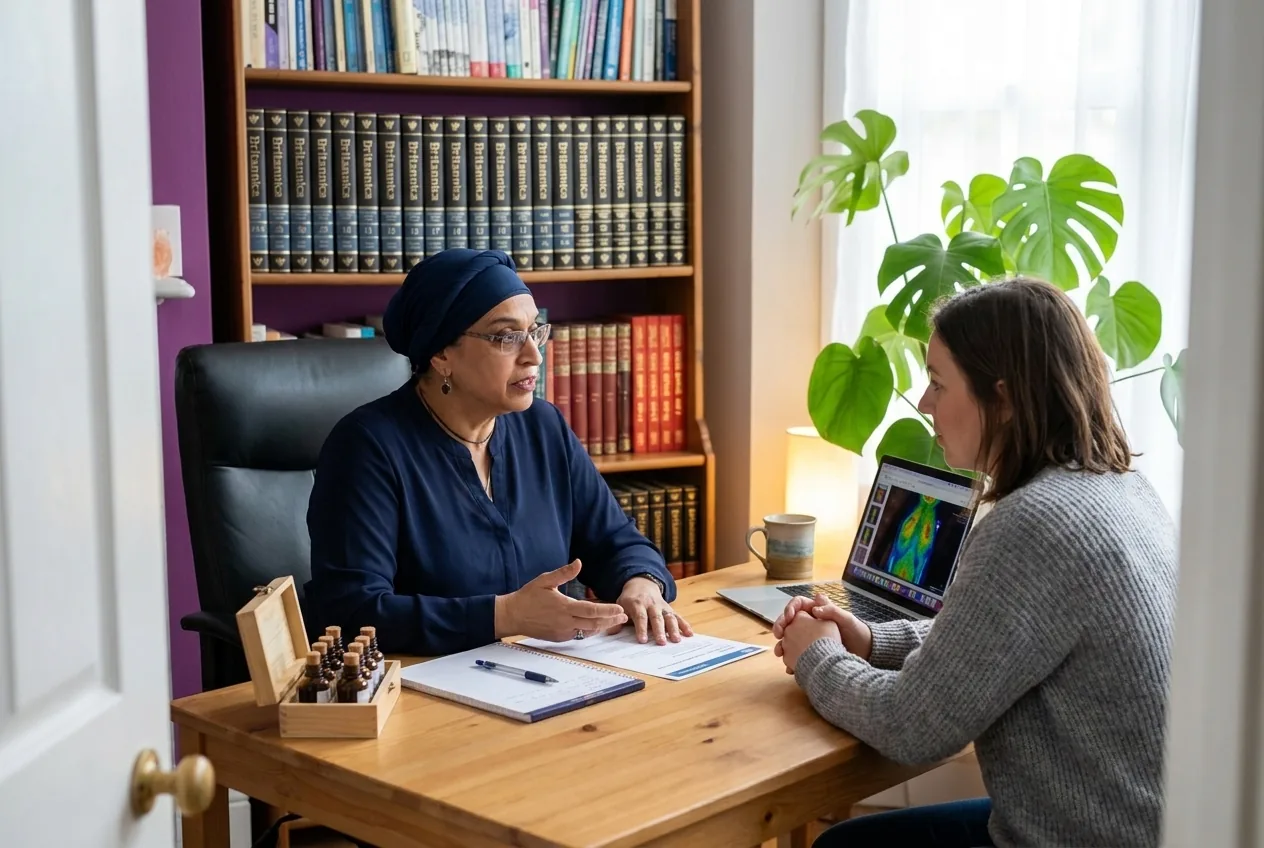
When I trained on the Qest4 system in Utah, I was likely the only homeopath in the room. Around me were psychiatrists, nutritionists, kinesiologists, biohackers. We were all looking at the same machine, the same software, the same raw data.
And every single one of us would have done something completely different with it.
A scan without a case history is half a map
The raw data is real. The frequencies are measured. The body responds. But what that response means depends entirely on who’s reading it, what they’ve trained in and how deep they’re willing to dig.
A woman came to me after eighteen years of digestive problems. Eighteen years. She’d been to naturopaths, other homeopaths, nutritionists. She’d improve for a stretch, then the symptoms would come right back. Every practitioner she’d visited looked at her gut and treated her gut. On paper, the approach made sense each time. And each time it failed her.
Any of them could have run a bioenergetic scan and seen “digestive imbalance” flagged in the data. A nutritionist would have adjusted her diet. Another homeopath might have given a gut remedy. A scan practitioner without clinical depth would have handed her a supplement list. They’d have had half the map and not even known the other half existed.
When I took her case, I did what I always do. I went back. When did this start? Eighteen years ago. What was happening in your life at that point? She’d been in Singapore. A family friend, someone her parents trusted completely, had been charging them double for university fees and pocketing the difference. When she discovered the fraud, the betrayal hit her like a physical blow.
She found that really hard to take in. Literally. Her body couldn’t digest the shock, and her digestive system had been expressing that ever since.
I gave her shock remedies linked to digestion. The symptoms cleared permanently. She never came back. She didn’t need to.
Eighteen years of seeing practitioners who treated her gut. Resolved by someone who asked what her gut was actually trying to tell her.
That’s the difference between a scan and a scan interpreted by someone who knows what questions to ask.
A nutritionist sees the data and reaches for supplements. A psychiatrist might flag anxiety markers. I look at it and think, right, when did this start? What was happening in your life? What’s the emotional root underneath the physical pattern?
The research backs this up
A 2025 study on therapist effects found that in less standardised therapies, where interpretation is central, the individual practitioner accounts for 10-16% of outcome variance. That’s not a minor variable. It’s the main one.
And here’s the uncomfortable truth the industry avoids. Most bioenergetic scan practitioners, including some charging premium prices, have never taken a detailed clinical case history. They haven’t studied the emotional-physical connections that shape what scan data actually means. They haven’t trained in a discipline that lets them act meaningfully on what they find.
The machine measures something real. Whether the person reading your results has the depth to make those measurements useful is the question nobody wants you to ask.
The scan is the violin. The practitioner is the violinist. A perfectly tuned violin without a skilled musician doesn’t produce music. It produces noise.
And right now, a lot of people are paying for noise and blaming the instrument.
If you’re wondering why, our article ‘Why Do Some Holistic Practitioners Charge Ten Times More Than Others?‘ explores the question in full — and the violinist is almost the entire answer.
Who is bioenergetic scanning NOT a good fit for?
I’d rather you know this before you spend a penny.
If you need a formal medical diagnosis. If you need documentation for insurance, a GP referral, workplace occupational health or legal proceedings, bioenergetic scanning can’t give you that. It identifies energetic patterns, not named medical conditions. You need conventional diagnostic testing, and any practitioner who suggests otherwise should concern you.
If your evidence threshold requires large-scale clinical trials. That’s a completely legitimate position. If you’ll only trust treatments backed by multiple published trials in mainstream journals, this technology doesn’t meet that bar.
I respect that. Functional medicine lab testing, blood panels, hormone profiling or gut microbiome analysis would suit you better. The NHS advises seeing a GP for any health condition rather than relying solely on complementary approaches, and that’s sensible guidance.
If you expect the machine alone to give you answers. Remember my Utah training experience? Without a practitioner who takes a deep case history and works the findings into a meaningful clinical picture, a scan is a waste of your money. If you’re booking because you want a printout of “what’s wrong” without the human depth behind it, you’ll leave disappointed.
What my own scan can and can’t do
I’ve spent this article being honest about the industry. Let me be equally honest about what I offer.
My RootScan at Rise Radiantly uses the same Qest4 device every other bioenergetic practitioner uses. The machine itself doesn’t become more scientifically validated because I’m the one operating it. You can explore what the RootScan Breakthrough Session includes here.
What I bring is 30 years of clinical case-taking, a BSc in Homeopathy, training alongside Paul McKenna in hypnotherapy, and a mind-body framework that lets me interpret the data in ways most scan practitioners can’t. But that doesn’t change the underlying evidence gap.
The scan still can’t replace a blood panel, an MRI or a specialist referral. It can’t detect structural problems. And its readings can be affected by how hydrated you are, the temperature of the room and your emotional state on the day.
I’ve also had scans where not much of anything useful showed up for that particular person on that particular day. I tell them that honestly rather than inventing significance in the data.
The limitations I’ve described throughout this article apply to my scan too. I’m not exempt from them just because I’ve been doing this for three decades.
Who IS a good fit?
If your blood tests keep coming back “normal” but you know something isn’t right, a scan interpreted by an experienced practitioner can sometimes reveal patterns that conventional testing misses. Not because the machine is cleverer than a blood panel, but because the practitioner asks different questions.
If you’re open to exploring the connection between your emotional history and your physical symptoms, and willing to do the work that comes after, this can be a genuinely useful starting point.
If you want to understand the why behind your symptoms, not just manage them, and you choose a practitioner with deep clinical training and a thorough case-taking process, bioenergetic scanning becomes one tool within a much bigger investigation.
A quick self-check before you book
Run through these honestly. There are no trick questions.
- Do your symptoms persist despite conventional tests coming back “normal”? (Yes / No)
- Are you open to the possibility that emotional or stress-related factors might be connected to your physical symptoms? (Yes / No)
- Are you willing to commit to a detailed case-taking conversation, not just a quick scan? (Yes / No)
- Can you accept findings framed as energetic imbalances rather than named medical diagnoses? (Yes / No)
- Have you already seen your GP to rule out anything that needs urgent medical attention? (Yes / No)
If you answered yes to four or more, bioenergetic scanning with the right practitioner is likely worth exploring.
If you answered yes to two or three, it might be worth a conversation, but go in with clear expectations about what the scan can and can’t do.
If you answered yes to one or fewer, this probably isn’t the right approach for you right now. And that’s a perfectly sensible conclusion. Consider functional medicine testing or a structured consultation with a specialist who works within the evidence framework you trust.

What happens when bioenergetic scanning goes wrong?
Two scenarios. Both happen more often than the industry admits.
Scenario one. You arrive expecting a clear answer
You’ve been to your GP. Blood tests normal. You’ve heard about bioenergetic scanning and you’re hoping, finally, for someone to explain what’s actually going on. You pay between £85 and £300.
The practitioner runs the scan. And the findings come back as “energetic imbalances” and “stress signatures.” Not a named condition you can take to a specialist.
You leave frustrated. You feel like you’ve been taken for a ride.
And the worst part? If those vague findings give you false reassurance, you might stop chasing the conventional investigation that could have caught something serious. The ASA’s June 2025 ruling against Navi Organics explicitly found that the advertising “discouraged essential treatment for conditions for which medical supervision should be sought.”
That’s not a theoretical risk. A bioenergetic scan is not a substitute for medical testing. If something is genuinely wrong, see your GP. I work alongside that, not instead of it.
Scenario two. A scan and a bag of supplements, with no understanding of why
A client of mine had been to another practitioner for a similar scan. The consultation was mainly about what she was sensitive to. The practitioner ran the scan, read off the results and handed her four or five different supplements. Lots of money spent. No case history taken. No questions about when her symptoms started, what was happening in her life at that point, or whether there might be something emotional underneath the physical pattern.
She walked away thinking, right, I’ll take these. And she did, faithfully, for weeks.
It didn’t shift.
She’d been handed products without understanding. Nobody had asked the questions that would have made those products make sense, or revealed whether they were even the right ones. She’d been given a printout and a shopping list where she needed a conversation and an investigation.
Supplements will help, yes. But you want to understand why your body is asking for them in the first place.
When she came to me, we went deeper. We sat down and I took her full timeline, from birth to now. We looked at what the scan was actually telling us underneath the surface numbers, and I cross-referenced that against her history, her emotional state, the life events that lined up with when her symptoms first appeared. And we built a proper approach. Not just “take this,” but here’s what’s happening, here’s why, and here’s what you do about it.
She booked her sister in for the following week.
That’s the difference between scan-and-dispense and clinical depth. The machine was probably identical in both consultations. The practitioner wasn’t.
What questions should I ask before booking a bioenergetic scan?
Before you book with anyone, including me, ask these.
“What training have you completed, and how many supervised clinical hours?” A weekend certification course isn’t the same as years of clinical training. The device is identical. The depth behind it isn’t.
“Do you take a full case history before interpreting the scan?” If the answer is no, walk away. Remember the woman with the supplement list? That’s what happens when you skip this step.
“What happens if the scan suggests something that needs medical investigation?” You want a practitioner with clear referral pathways. Someone who’ll say “see your GP about this” without flinching. If they position themselves as a replacement for medical care, that’s a red flag.
“Are you registered with a professional body, and do you carry professional indemnity insurance?” The Professional Standards Authority (PSA) accredits voluntary registers for complementary therapists in the UK. Being on a PSA-accredited register is the strongest credibility signal available in this space.
“Can you explain the limitations of what the scan can tell me?” Any practitioner who can’t name the boundaries of their own technology isn’t someone you should trust with your health.
A difficult truth about your situation
Before I say this, don’t beat yourself up, because you didn’t know.
Some of the frustration people feel with bioenergetic scanning isn’t caused by the technology or the practitioner. It’s caused by arriving with expectations the technology was never designed to meet.
According to the British Journal of General Practice, about one in four GP consultations in the UK involve symptoms that can’t be fully explained by conventional testing. That’s a formally recognised clinical challenge, not your imagination.
But the gap between “my doctor can’t find anything” and “this scan will tell me what’s wrong” is where people get hurt. Financially and emotionally.
You shouldn’t have to choose between “true believer” and “total sceptic” just because nobody’s been honest enough to give you the middle ground. That’s not your failing. That’s the industry’s.
If you’ve already been through holistic approaches that didn’t deliver, that wariness is completely understandable — our article ‘What If Holistic Healing Does Not Work for Me, and I Have Already Tried Everything?‘ speaks directly to that experience.
The honest path? See your GP for anything that could be serious. Use bioenergetic scanning as one tool within a broader investigation, not a replacement. And choose your practitioner based on their clinical depth, not the machine they happen to own.
What it costs you to keep waiting
Here’s what I see with the women who come to me. The fatigue that sleep doesn’t fix. The anxiety that medication dulls but never resolves. The migraines, the gut issues, the feeling of being not quite right that no GP can explain.
Every month that goes unaddressed is a month where the root cause, whatever it is, keeps compounding. If that root is emotional or energetic rather than something that shows on a blood panel, conventional testing will keep returning “normal” while your body gets louder about what it needs you to hear.
I’m not saying bioenergetic scanning is the answer. I’m saying not looking has its own cost.
You’ve now got something most people searching this question don’t have. A clear understanding of what the technology measures, where the evidence stands, what the disclaimers mean, and exactly what to ask any practitioner before handing over your money. That puts you in a fundamentally different position from where you were an hour ago with those fifteen browser tabs.
If you’re still working things out, the five questions above are your due diligence checklist. Use them with anyone. And if you want to go deeper on what the scan involves and what it costs, I’ve written about that separately in the full guide to bioenergetic scanning.
If you’ve got questions about whether this fits your specific situation, I offer a free 30-minute health audit where we can talk it through honestly. No obligation, no pressure. And if you’ve already decided you want to see what the scan reveals, you can explore what the RootScan Breakthrough Session includes.
If you decide this isn’t for you, that’s absolutely fine. This article will still be here when you need it.
Sameena Khan
Founder, Rise Radiantly
Frequently asked questions
Can a bioenergetic scan be done remotely?
Yes. I need your name and date of birth. People find this hard to believe, and honestly, I understand why.
I explain it like this. How do you make a phone call? You dial a unique number. Your name and date of birth is unique to you. That’s all I need.
Clients have told me they felt physical sensations during remote scans. There’s no controlled evidence for that, so I mention it as what they’ve reported, nothing more.
Does the scan hurt?
No. Completely non-invasive. No needles, no blood, no discomfort. Some people ask whether they’ll get an electric shock. You won’t.
Can I have a bioenergetic scan alongside my current medical treatment?
Absolutely. I never take people off medication. If you need to take your antibiotics, take them. If you’re on thyroid medication, keep taking it. I work alongside your GP, not instead of them.
If you’re on long-term medication and want the detail, I’ve written about taking homeopathic remedies alongside current medication separately.
How long does a scan session take?
A thorough session should include a full case history alongside the scan itself, because the data without context is meaningless. I keep saying this, right? The scan alone is half a map.
At Rise Radiantly, the RootScan Breakthrough Session includes a 90-minute private insight and strategy session. Some practitioners offer 30-minute appointments for £30-£100. You get what you pay for in terms of interpretive depth.
What if the scan doesn’t find anything useful?
Then that’s useful information too. It might mean your imbalances aren’t showing up energetically in that moment, or it might mean the root cause needs a different kind of investigation.
I’d never pretend the scan catches everything. If something doesn’t show, I’ll say so. And we’ll look elsewhere.
Still have questions? Book a free 30-minute health audit and let’s talk through your specific situation.