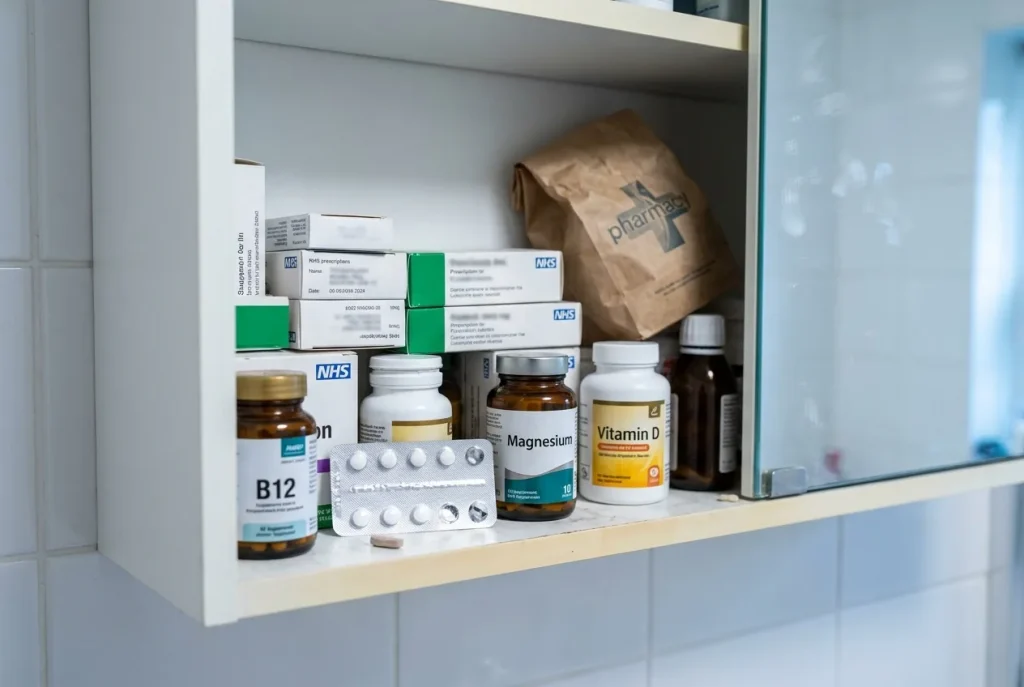
You saw the programme price and thought “I can’t justify that.” I know. Every person who lands on my pricing page has that same moment. You’re comparing a £9,999 healing programme to a £9.90 NHS prescription and the maths looks mad.
But here’s what nobody asks you. Have you ever actually added up what you’ve spent on prescriptions, supplements, private appointments and therapy over the past five years? Most people haven’t. When they do, the number stops them cold.
For a person managing two or three chronic conditions, the conventional pathway typically accumulates to between £5,000 and £50,000 over a decade, depending on how much private care and supplementation is involved. A front-loaded root cause programme at £9,999 can genuinely cost less. But only if it gets to what’s underneath, and only if you do the work.
I need to be straight with you. I offer root cause healing programmes at Rise Radiantly, so I have skin in this. And there’s a real limitation you should know about before you read any further.
If you’ve been on multiple medications for 15 to 20 years, an eight-week programme may show only moderate improvement in that timeframe. Some chronic autoimmune conditions respond more slowly and less predictably, even with full commitment. I only take four clients per quarter on the intensive programme, and the wait can stretch to three to six months.
And if your condition is well managed on a single medication with no side effects, no supplement stacking and no escalation, the NHS pathway with a Prescription Prepayment Certificate (PPC) at £114.50 a year is genuinely hard to beat.
If that’s your situation, this article will confirm it. Read on if your experience looks more like a growing pile of prescriptions, rising supplement bills, the occasional private consultant, and symptoms that are managed but never actually gone.
Key Takeaways
- Most people are managing 2 to 3 chronic conditions are spending £3,000 to £5,000 a year once you total prescriptions, supplements, private appointments and therapy. Nobody ever asks them to add it up
- The prescribing cascade is real. One drug’s side effects require another drug, which depletes a nutrient, which requires a supplement. Each step adds to the monthly bill
- Root cause healing costs £2,222 to £9,999 upfront with no ongoing monthly charges if the underlying condition resolves
- Medication genuinely wins when a single drug manages your condition with no escalation, no side effects and no supplement stacking
- The biggest cost doesn’t appear on any invoice. Nobody bills you for years of working at 70% capacity
Looking for something specific?
- Want to know what you’ve actually been spending? Jump to the medication cost breakdown.
- Wondering what the programme costs and what’s included? See the root cause healing pricing.
- Need to see all four pathways side by side? Go straight to the comparison table.
- Want to know when medication is genuinely the better choice? Read that section here.
What does medication actually cost over 5 and 10 years?
A professional managing two or three chronic conditions is typically spending £3,000 to £5,000 a year on prescriptions, supplements, private appointments and therapy. Nobody ever hands you that figure. I know, because I ask every client who sits across from me whether they’ve ever totalled it. Almost none of them have.
Your GP doesn’t tally your annual prescription spend. The pharmacist doesn’t ask how much you dropped at Holland and Barrett last month. The private consultant you saw in November doesn’t reference the one you saw in March.
Each cost arrives separately, feels manageable on its own, and vanishes into the monthly churn of direct debits and contactless payments. So it never feels expensive. That’s exactly the problem.
Let’s do the maths.
The current NHS prescription charge in England is £9.90 per item. If you’re managing a thyroid condition, irritable bowel syndrome (IBS) and anxiety, you could easily be on three items a month. That’s £356 a year in prescription charges alone.
A 12-month PPC caps this at £114.50, which is genuinely good value. Around 2.2 million people in England now buy one.
But roughly 872,000 patients who paid per item in 2023/24 could have saved an average of £41 each by getting a PPC and didn’t. If you’re on multiple prescriptions and haven’t looked into this, do it now. Seriously.
A PPC only covers prescriptions, though. It doesn’t cover the supplements you’re buying because your medication depletes certain nutrients. It doesn’t cover the private GP appointment you booked when you couldn’t get an NHS slot for three weeks. And it doesn’t cover the therapy sessions you started when the anxiety wouldn’t shift.
Here’s what a realistic year actually looks like for a professional managing two or three conditions. Prescriptions with a PPC at £114.50. Supplements at £50 to £150 a month, so £600 to £1,800 a year. One private specialist appointment at £200 to £620. Fortnightly therapy at £90 a session, which is £2,160 a year.
Even in a moderate scenario, you’re looking at £3,000 to £5,000 a year. Over five years, that’s £15,000 to £25,000. Over ten years, £30,000 to £50,000.
The vast majority of people I sit across from have never done this calculation. Not because they’re bad with money. Because no practitioner, no GP, no pharmacist has ever asked them to.
What are the three hidden cost drivers in long-term medication?
The £9.90 prescription charge isn’t the problem. It’s what happens after year two, year five, year eight that nobody warns you about. Three things quietly multiply your costs, and none of them show up on a single receipt.
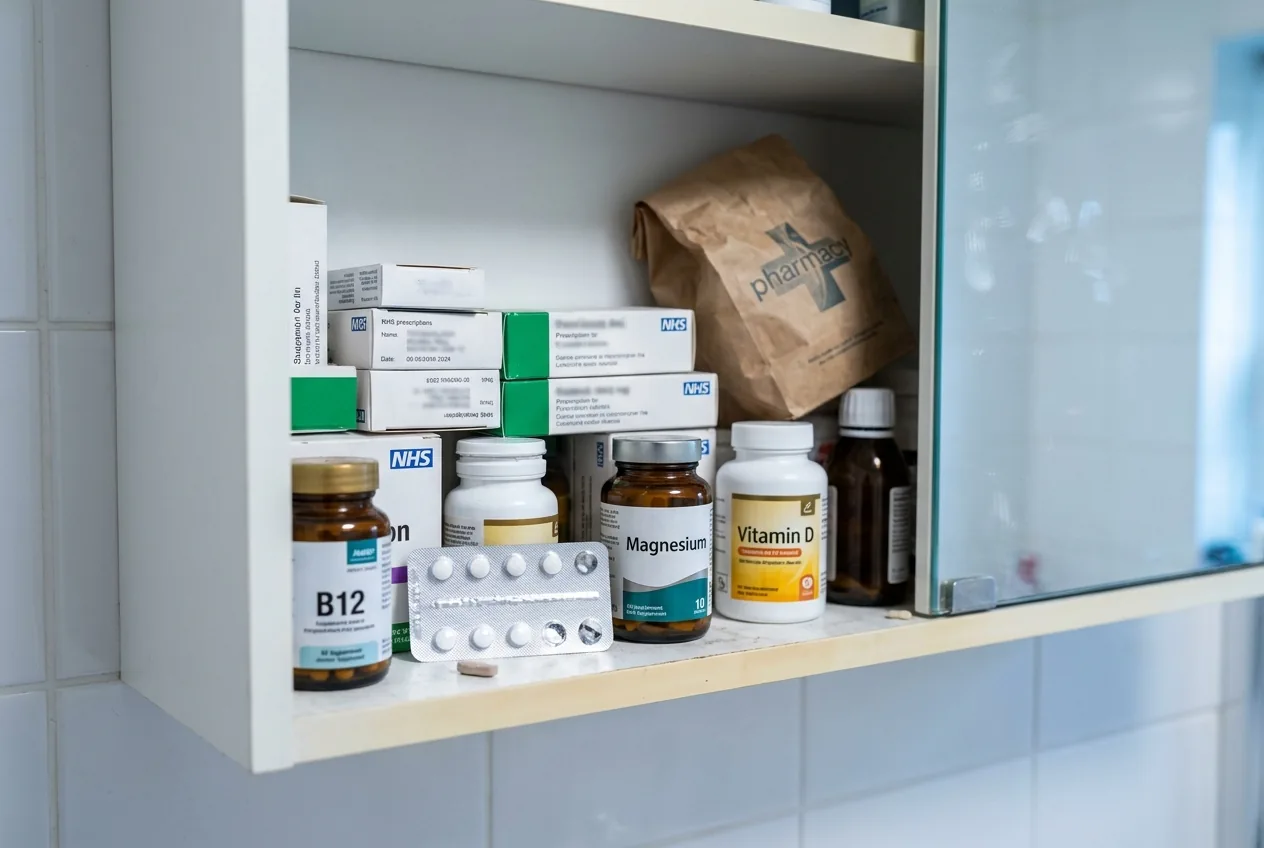
The side-effect cascade. The NHS Specialist Pharmacy Service has a name for this. They call it a “prescribing cascade.” You’re given an anti-inflammatory for pain. It irritates your stomach. You’re prescribed a proton pump inhibitor (PPI) to protect your gut. The PPI, taken long-term, depletes your vitamin B12. National Institute for Health and Care Excellence (NICE) guidance now lists both PPIs and metformin as risk factors for B12 deficiency.
So you end up supplementing B12 out of your own pocket to compensate for a drug that was prescribed to manage the side effect of another drug. One prescription became three costs.
People come to me with carrier bags of medication. Literally carrier bags. And when we look at the timeline, we can trace it back. One drug. Then a second to manage the first. Then a third. Each one adding to the monthly cost and none of them getting to the why.
Dosage escalation. Prescription items dispensed in England increased by 16% between 2015 and 2025. That’s 170 million additional items nationally. Even when the NHS specifically targets this through Structured Medication Reviews, the average net reduction is just 0.6 items per review. Barely a scratch on a typical list of 10 to 13 medications.
The system adds. It very rarely subtracts.
Supplement stacking. Long-term medication depletes nutrients your body needs. Metformin reduces B12 absorption. Statins can affect CoQ10 levels. PPIs interfere with magnesium and calcium. So you buy these nutrients over the counter. Market data from Mintel puts the typical chronic-condition supplement spend at £50 to £150 a month. Over a decade, that’s £6,000 to £18,000 in out-of-pocket costs that nobody counts as part of your “medication” spend.
And here’s the thing that changes the whole picture. There’s a difference between replacing a function and restoring it. Supplement stacking replaces what the medication takes away. The medication itself replaces what the body has stopped doing. Nobody asks *why* the body stopped. Nobody asks whether it could start again.
I had a woman come to me who’d been on levothyroxine for years. It’s the most commonly prescribed thyroid medication in the UK, and she’d been told the same thing every thyroid patient hears. “This is it. You’ll be on this for life. Full stop.”
She’d accepted that. What she hadn’t accepted, because she’d never calculated it, was everything that had quietly stacked up around that single prescription. The levothyroxine had been causing side effects. The side effects had required additional drugs. Her GP had advised B12 and selenium supplements to compensate for what the medication was depleting. She’d paid for two private endocrinology appointments when the NHS waiting list stretched past four months.
When I asked her to add it all up, her face changed. Her annual health spend had quietly crept into thousands of pounds. What started as one thyroid prescription had become a financial commitment far beyond anything she’d signed up for.
And here’s where the cost comparison turns on its head. When we went through her timeline and got to what was underneath the thyroid issue, her body began producing its own natural thyroxine again. Working alongside her GP throughout, she was weaned off the levothyroxine. Her blood tests came back normal.
The medication had been replacing a function her body had stopped performing. Nobody had asked why it stopped, or whether it could be restored. Once we addressed the root, the body did its own work. And the indefinite monthly cost of replacing that function dropped to zero.
Not every thyroid case responds this way. I’ll never promise yours will. But the financial reality of supplement stacking is clearest when you see it in a real woman’s bank statements. She wasn’t paying £9.90 a month for one prescription. She was paying for the prescription, the supplements to offset it, the additional drugs for its side effects, and the private appointments the NHS couldn’t schedule fast enough.
That’s the invisible ledger. Three drivers. Three quiet multipliers. None of them showing up on any single receipt.
What does root cause healing cost upfront, and what happens to costs afterwards?
Right. You’ve seen what the medication pathway actually costs when you total it. Now let me be equally transparent about mine, because you deserve the same honesty on this side of the comparison.
My RootScan Breakthrough Session is £2,222. That includes a full bioenergetic scan, a homeopathic consultation, bespoke remedies, an energy blueprint report, a strategy session with an action plan, a follow-up integration call, and two weeks of direct access to me via WhatsApp. No hidden testing fees. No supplement upsells appearing later.
The Rooted Radiance Immersion, my eight-week programme, is £9,999. That includes two bioenergetic scans, four homeopathic consultations, six hypnotherapy sessions, eight weekly coaching sessions, all your remedies, and eight weeks of WhatsApp support. Everything is included. For a closer look at our article ‘What Am I Actually Paying for in a Premium Holistic Healing Programme?‘, I’ve written that up separately.
The way it works financially is the opposite of medication. Medication starts cheap and escalates year on year. Root cause healing starts high and, if it gets to what’s underneath, the ongoing cost drops to occasional maintenance or nothing at all.
The goal is that you don’t need me long-term. I’m giving you tools you take with you for life.
I’ve watched this play out in practice. One of my clients is a 72-year-old man who’d been managing diabetes with medication for years. That’s a condition that typically locks you into perpetual prescription costs, blood sugar monitoring supplies and the constant risk of escalation to additional drugs.
He committed fully. Whatever I said, he did. He was so disciplined his kids complained about it.
Over time, working alongside his GP throughout, we weaned him off every single medication. He still comes to his appointments and brings his blood sugar readings on a slip of paper.
Stable. No medication. Drug-free.
His annual medication cost went from hundreds of pounds to zero. The front-loaded investment eliminated an indefinite recurring cost. But this matters, right? It worked because he did the work. There’s no magic pill. There is a magic process if you’re willing to be part of it. And if that level of commitment isn’t there, the investment doesn’t deliver.
When is medication genuinely the better financial choice?
Before I say this, don’t beat yourself up if conventional medication is working for you. There are clear situations where it’s the right path, full stop.
Medication is the right choice if you’re in an acute crisis. Severe thyroid emergencies, acute psychiatric episodes, serious infections. That’s what A&E and your GP are for. Don’t wait for me. Go.
It’s the right choice if a single, well-tolerated medication manages your condition with no dose escalation, no side effects requiring additional drugs and no supplement stacking. The NHS pathway with a PPC at £114.50 a year is excellent value. NICE guidance on multimorbidity supports structured medication management for exactly these scenarios. Not every condition has a deep emotional root cause, and not every medication story turns into a 20-year escalation.
It’s the right choice if the root cause is purely situational. A toxic work environment. A difficult relationship. Changing the situation is more effective and cheaper than investing in a healing programme.
Root cause healing is not the right choice if you expect to hand over £9,999 and be passively fixed without doing the breathwork, journalling and remedy schedules the programme requires. The investment is wasted without your full commitment. You are financially better off continuing with medication where the effort required is simply taking a tablet. I’ve written more about who root cause healing is and isn’t suited for if you want the complete picture.
And it’s not the right choice if you’ve been on multiple medications for 15 to 20 years and need results within weeks. Some chronic autoimmune conditions respond more slowly and less predictably, and an eight-week programme may show only moderate improvement for long-standing, heavily medicated conditions. I’ll be honest about that in your free 15-minute health audit rather than take your money and hope for the best.
Having said all of that, remember the woman on levothyroxine I described earlier? She’d been told she’d be on thyroid medication for life. Her annual health spend had silently expanded into thousands. When we addressed what was underneath, her body began producing its own thyroxine again and she came off the medication entirely with normal blood tests.
Not every thyroid case responds to root cause work. I’ll never promise yours will. But the conventional narrative that once you’re on thyroid medication there’s no other path isn’t always the whole story.
The question is whether your situation fits the well-managed, single-medication picture. If it does, stay on it. If it doesn’t, and you’re watching the drugs, supplements and appointments multiply year on year, that’s when the financial comparison shifts.
What is the cost you never see on an invoice?
Here’s the one nobody talks about, because there’s no line item for it.
If you earn £60,000 and you’re running at 70% capacity because of brain fog, fatigue and decision paralysis, you’re losing the equivalent of £18,000 a year in output. Not money that leaves your bank account. Money that never arrives. Over five years, that’s £90,000 in a career that’s quietly stalling while you push through another afternoon wondering why you can’t think straight.
The Health and Safety Executive reports that 22.1 million working days were lost to work-related stress, depression and anxiety in 2024/25 alone. Deloitte estimates poor mental health costs UK employers £51 billion a year, with £24 billion from presenteeism. That’s people showing up but running at a fraction of what they’re capable of.
I see this in my clinic all the time. High-performers who are sharp, capable, brilliant at what they do. But they’re drained by 2pm. The promotion they didn’t go for because the thought of presenting made their stomach flip. The business idea they shelved because by 7pm there was nothing left. The relationship strain from being irritable, exhausted and emotionally absent, night after night.
No GP includes “career stagnation” on your prescription summary. But if you honestly calculated the gap between who you are now and who you’d be at full capacity, that number would dwarf both the prescription bill and the programme fee combined.
Nobody sends an invoice for a life lived at half speed. But the cost is there. You feel it every single day.
Side-by-side comparison. Four pathways over 1, 5, and 10 years
I’ve mapped out four realistic pathways below using published UK cost data. My own approach at Rise Radiantly is included as two of these, the standalone RootScan and the eight-week Immersion, and I’ve applied the same cost scrutiny to my pricing as to every other pathway.
The table gives you the numbers at a glance. The detail underneath explains what each pathway includes and where the figures come from.
Estimated cumulative cost of four chronic condition management pathways over 1, 5, and 10 years in the UK (2025/26 pricing)
| Criterion | NHS medication only | RootScan Breakthrough | Private functional medicine | Rooted Radiance Immersion |
|---|---|---|---|---|
| Year 1 cost | ~£350 | £2,222 | ~£3,200 | £9,999 |
| Year 5 cumulative | ~£1,770 | £2,222 | ~£12,500 | £9,999 |
| Year 10 cumulative | ~£3,540 | £2,222 | ~£24,000 | £9,999 |
| Ongoing monthly costs | PPC + supplements | None stated | Supplements + follow-ups | £1,111/month if needed |
| Remedies/supplements included | No | Yes | No (separate cost) | Yes |
| Best suited for | Single stable condition | First-step diagnostic | Lab-data-first buyers | Multi-condition root cause |
| Cost data source | NHS published charges | Company pricing | Published clinic pricing | Company pricing |
The NHS-only pathway is genuinely the cheapest if your condition stays stable. But for people whose costs have been climbing, the front-loaded pathways often work out less expensive over a decade than the drip-drip of the conventional route.
Find the pathway that looks most like your situation.
Pathway A. NHS medication only (PPC, minimal supplements, no private care)
Year 1 is approximately £350. Year 5 is approximately £1,770. Year 10 is approximately £3,540. This includes the PPC at £114.50 and low-range supplements at around £240 a year. No private consultations, no therapy. If your condition genuinely stays stable on this, it’s the most affordable path by a long way.
Pathway B. Rise Radiantly RootScan Breakthrough (standalone diagnostic)
Year 1 is £2,222. Year 5 is £2,222. Year 10 is £2,222.
A one-time investment covering a full bioenergetic scan, homeopathic consultation, bespoke remedies, energy blueprint report, strategy session, follow-up integration call and two weeks of WhatsApp access. What happens next depends on what the scan reveals and what you decide to do about it.
Some women get the clarity they need from this session alone. Others move to the full programme, and the £2,222 is credited toward the £9,999.
Pathway C. Private functional medicine (mid-usage)
Year 1 is approximately £3,200. Year 5 is approximately £12,500. Year 10 is approximately £24,000. Based on published pricing from clinics like Synthesis Clinic, which charges £870 for an initial package, plus follow-ups at £275 to £395, lab testing and ongoing supplements. If you value hard laboratory data as your starting point, this approach delivers it. But the supplement and testing costs add up quickly.
Pathway D. Rise Radiantly Rooted Radiance Immersion (8-week programme)
Year 1 is £9,999. Year 5 is £9,999. Year 10 is £9,999.
All-inclusive. Two bioenergetic scans, four homeopathic consultations, six hypnotherapy sessions, eight coaching sessions, remedies and eight weeks of direct WhatsApp support. If the underlying condition resolves fully, there are no ongoing costs.
Now, I need to be honest about the assumptions here. These cost comparisons are modelled by combining separate public data sources. No single published study compares all four pathways head to head, and no independent economic research tracks holistic programme outcomes against long-term medication costs.
Pathway A is genuinely affordable and may be all you need if your condition is straightforward. Pathway D assumes the programme gets to the root and resolves the underlying condition. If it doesn’t, and maintenance is needed at £1,111 per month, the 10-year cost rises well beyond £9,999.
The comparison only works if you’re honest about which pathway matches your reality right now. Not the one you hope for. The one you’re actually living.
My honest recommendation
After 30 years of sitting across from clients in exactly your position, here’s what I’d say.
Stick with medication if your condition is managed by one drug, you’ve got no side effects, your supplement spend is minimal and your quality of life is good. A PPC at £114.50 a year is hard to beat. Don’t let anyone, including me, talk you out of something that’s working.
Consider root cause healing if your medication list has grown over the years, your supplement spend has crept up, you’ve seen multiple specialists without lasting resolution, and you’re privately aware that your symptoms are managing you more than you’re managing them. The upfront investment is higher. But when you lay it against what you’ve already spent, and what you’ll continue spending if nothing changes, the comparison often surprises people.
Be cautious of any approach, including mine, if you’re not ready to actively participate. The investment is wasted without your full commitment to the process, the remedies, the homework. If that commitment isn’t there, you’re financially better off with medication.
Every month you continue on a pathway that manages symptoms without getting to the root, you’re adding another £150 to £300 to a bill that nobody is totalling for you. Over five years, that’s £9,000 to £18,000 on a revolving door of prescriptions and appointments that leave you exactly where you started.
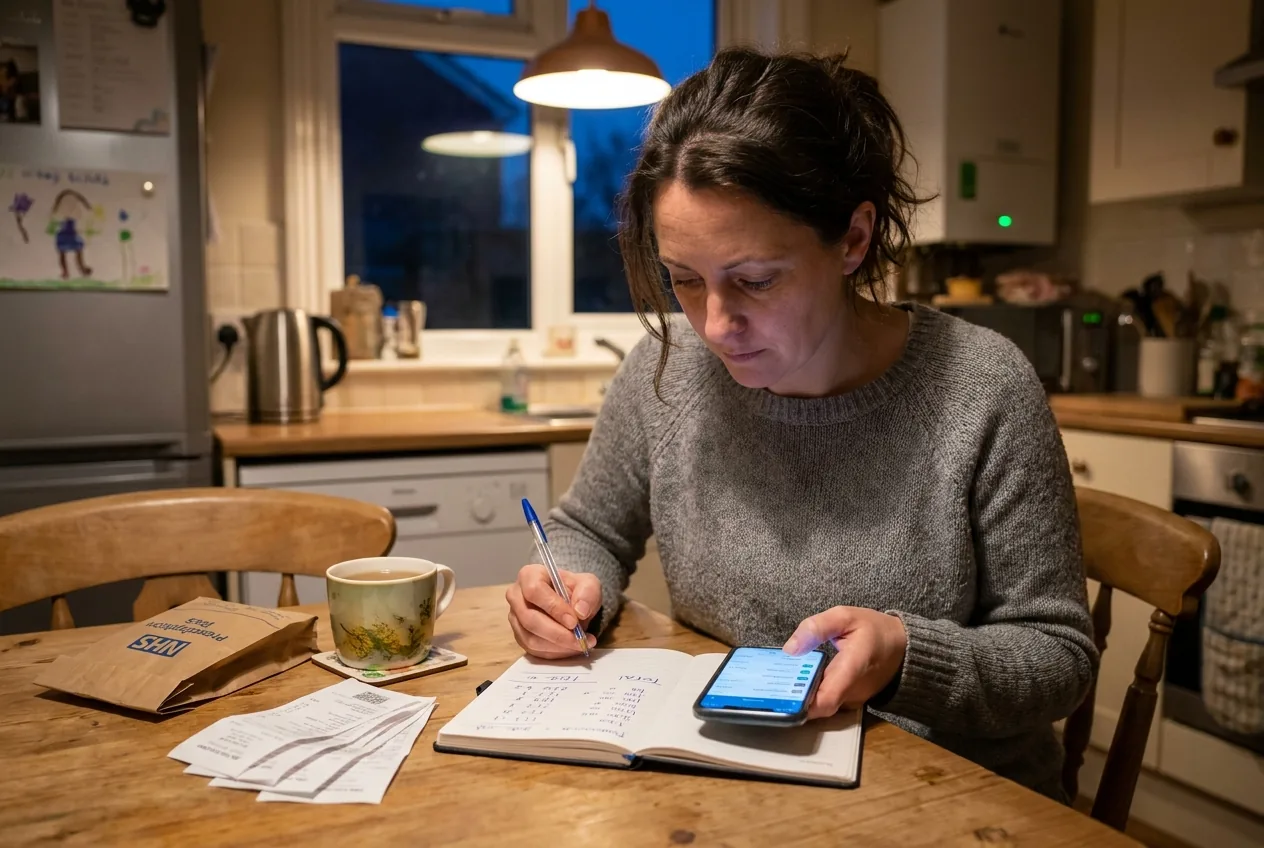
The honest next step is to do your own calculation. Open your banking app tonight. Search for your pharmacy, your supplement brands, your therapist’s name. Add it up over the past twelve months.
Then multiply by five.
That number is your real comparison point. Not the £9.90 on the prescription bag.
If you’re still working out whether root cause healing fits your situation, the burnout and fatigue recovery guide walks through different recovery pathways and how they fit together. If you want to explore whether this investment makes financial sense for you specifically, book a free 30-minute health audit and I’ll look at what you’ve been spending with you. Or if you already know you want to see what your body is telling you, explore what the RootScan includes.
No pitch. No pressure. Just the maths.
Sameena Khan
Founder, Rise Radiantly
Frequently Asked Questions
Do I have to stop my medication to work with you?
No. I never take anyone off their medication. That’s a hard rule. I work alongside it, and if we reach a point where your GP agrees a reduction makes sense, we do that together with proper medical oversight. If you need your medication right now, take it. I’ll help you support your body around the drug layer. I’ve written separately about taking homeopathic remedies alongside conventional medication if that’s on your mind.
What if the programme doesn’t work for me?
In my experience, the most common reason things don’t shift is non-compliance. Not taking remedies as prescribed, not doing the homework, not engaging with the emotional investigation the programme asks of you. If you commit fully, the vast majority of people see measurable shifts. But I can’t promise a specific outcome, because healing timelines vary with how long you’ve had the condition, how many medication layers are involved and how your body responds. Some autoimmune conditions take longer than eight weeks.
Can I start with the RootScan instead of the full programme?
Yes. The RootScan Breakthrough Session at £2,222 is a complete standalone experience. A lot of people start there to understand what’s going on in their body before deciding whether the full programme is the right next step. If you then move to the Immersion, the RootScan fee is credited toward the £9,999. You don’t pay twice.
How does your pricing compare to other holistic practitioners?
A standard homeopathic consultation in the UK runs £30 to £125, according to Cancer Research UK. Standalone bioresonance scans from other clinics range from £80 to £300. Hypnotherapy sessions typically cost £80 to £250. If you bought each of those separately from individual practitioners, you’d spend more overall and none of them would be talking to each other. My pricing reflects the integration. Everything in one programme, with one person who understands the full picture. That’s the difference. And it’s a big one.
Is bioenergetic scanning the same as a medical diagnosis?
No. I don’t diagnose. A bioenergetic scan maps what’s happening at an energetic level. It’s not an MRI, not a blood test, not a clinical assessment. Combined with 30 years of clinical experience, it gives me a picture of where your body is out of balance and why. If you need a formal medical diagnosis, see your GP first. I’ll work with whatever they find.
What about the Prescription Prepayment Certificate? Doesn’t that make medication very affordable?
It does, and I’d recommend it to anyone on multiple prescriptions. A PPC caps your annual prescription cost at £114.50 regardless of how many items you’re on. If prescriptions are your only health cost, it’s excellent value. But a PPC doesn’t cover supplements, private consultations or therapy. And it doesn’t reduce the cost of running at 70% capacity at work for years on end. The PPC makes the visible cost affordable. The question is what’s happening with the invisible costs alongside it.
Still wondering whether the numbers add up for your situation? Book a free 30-minute health audit and let’s look at it together.