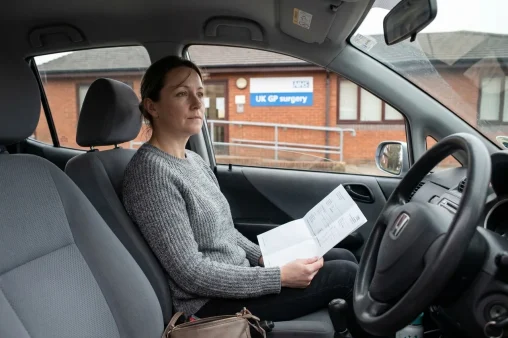
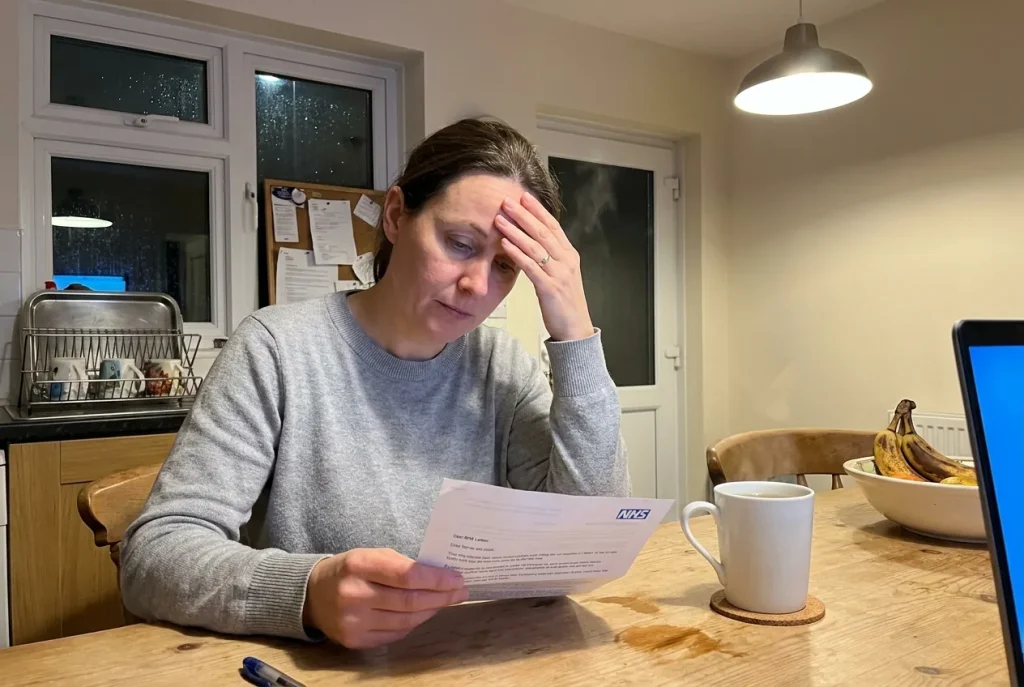
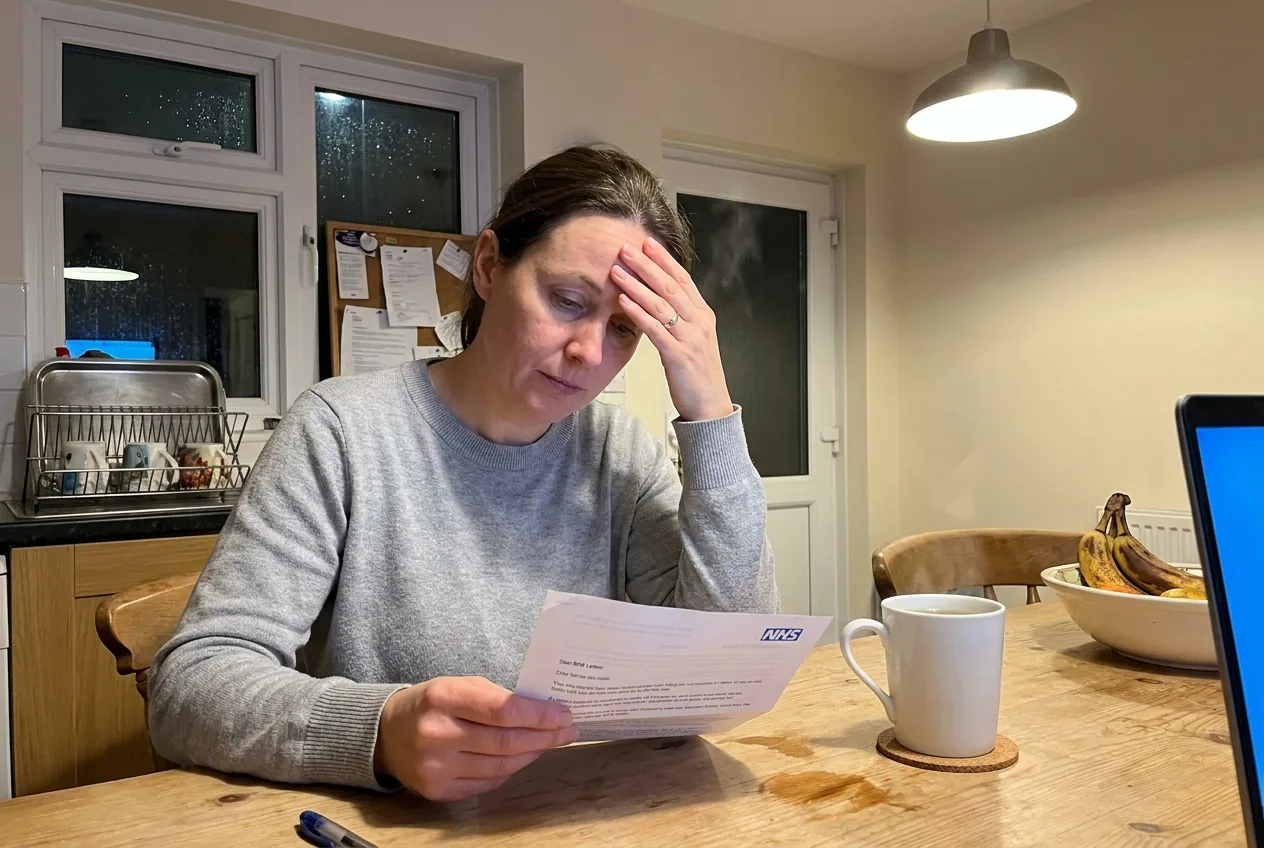
You’ve had the blood tests done. Possibly more than once. The GP says everything is within normal range. And you’re sitting there thinking: then why do I feel so terrible?
The most common reason is straightforward, and it isn’t about your GP getting it wrong. Standard NHS blood panels were designed to detect established disease. Anaemia. Diabetes. Thyroid failure. Kidney problems. They’re genuinely good at catching those things. But they were never built to detect the functional decline, the hormonal fluctuations, or the cumulative stress load that causes months of crushing fatigue, brain fog, and anxiety in women whose bloodwork shows green across the board. Your results can sit inside the “normal” range while your body is operating at the depleted end of every marker at the same time. And the system has no way of telling you that.
I should be upfront with you. I’m Sameena Khan, and I run Rise Radiantly, a holistic health practice offering bioenergetic scanning, clinical homeopathy, hypnotherapy, and coaching. So I have a perspective on this, and I want you to know that before you read any further. I’ve tried to write the most honest explanation I can, including where my own approach falls short.
Key Takeaways
- Standard blood panels test for disease, not decline. If every marker sits inside the population-level “normal” range, the system stops looking. Even if you’re running on fumes.
- Up to 30% of people may be misclassified by those broad reference ranges. Your TSH that reads “normal” for the average person may not be normal for your body.
- Blood tests can’t measure what started the problem. The grief you never processed, the shock from years ago, the nervous system that hasn’t switched off in months. None of that shows on a standard panel.
- If you’ve got sudden, severe, or worsening symptoms, this article isn’t your next step. You need urgent GP investigation. Full stop.
- A “normal” result doesn’t mean nothing is wrong. It means the tests being run weren’t built to find what’s wrong with you.
Here for one specific thing?
- Wondering what a standard blood test actually measures? Jump to the breakdown.
- Want to understand why your results say “normal” when you feel terrible? See the normal-versus-optimal gap.
- Curious whether emotional or stress-based roots could be the missing piece? Read about what tests can’t see.
- Need to know when “normal” results should trigger more investigation? Go straight to the red flags.
- Ready to explore what other diagnostic approaches exist? See the options and their limitations.
What does a standard NHS blood test actually check for?
Most people assume their GP tested “everything.” They didn’t.
A standard NHS full blood count measures haemoglobin and red blood cell counts (checking for anaemia), white blood cells (looking for infection or immune response), and platelets. Then there are your kidney and liver markers, and blood sugar for diabetes. Your GP might also request Thyroid-Stimulating Hormone (TSH).
These tests are genuinely good at what they’re designed for. They catch anaemia. They flag diabetes. They identify kidney or liver problems. I always tell people, get your blood tests done. Let’s rule out the serious stuff first.
What they were never built to detect is the spectrum between “you’re fine” and “you have a diagnosable disease.”
Think of it like checking the oil and water in your car. If the oil’s bone dry, you’ll know. But if the driver is exhausted, the tyres are slowly deflating, and the tracking’s been off for six months, that oil-and-water check won’t catch any of it.
And here’s something that surprises most people. Many markers you’d expect to be included aren’t part of the standard panel at all. Free T3 and Free T4, the hormones that actually tell you how your thyroid is functioning, are only added if your initial TSH comes back abnormal. Manchester University NHS Foundation Trust confirmed this cascade policy. TSH first. Only if that’s flagged do the deeper markers get tested.
Ferritin. Vitamin D. Sex hormones. Cortisol. None of them routinely included unless your GP specifically requests them.
So when you’re told “your blood tests are normal,” what that actually means is: the limited markers we tested didn’t cross the threshold for disease. It doesn’t mean everything is working well.
Why can my results be normal when I feel terrible?
The “normal” range on your blood test isn’t based on what’s optimal for you. It’s based on the middle 95% of results from a reference population of apparently healthy people.NHS laboratory guidance confirms that by definition, 5% of healthy individuals will fall outside that range, and plenty of symptomatic people will sit comfortably inside it. The actual test method varies between hospitals, too. A “normal” at one place might not be “normal” at another.
Take your thyroid, right? The standard NHS TSH range runs from roughly 0.35 to 5.0 mIU/L. If your TSH comes back at 3.8, it’s technically within range. No flag. Your GP’s system shows green. But functional and integrative practitioners often investigate further at anything above 2.0 to 2.5, particularly in symptomatic women.
It isn’t a simple picture, though. I’m not going to pretend it is. NICE guidelines don’t recommend treating subclinical hypothyroidism unless TSH is persistently above 10 mIU/L, and there are good reasons for that caution. A 2024 study in the journal Thyroid documented real risks from overtreating borderline results, including atrial fibrillation and osteoporosis. Nobody should be rushing to medicate a number.
But here’s what is worth knowing. A 2024 study on personalised TSH reference ranges found that applying genetically-informed ranges, rather than one-size-fits-all population averages, reclassified the thyroid status of up to 30% of individuals.
Nearly one in three people told they’re “normal” may not be normal for them.
The same pattern shows up with ferritin. A 2024 UK study of over 25,000 participants found more than a four-fold difference in the upper limit of “normal” between different UK laboratories. And the study didn’t even stratify by menopausal status or how many pregnancies a woman had. So the reference range your result is being measured against may have nothing to do with what’s normal for your body, at your stage of life.
If your symptoms span thyroid, perimenopause, or chronic conditions alongside normal results, our women’s hormonal health guide covers how these diagnostic gaps play out across the conditions most commonly missed.
Here’s the uncomfortable truth nobody tells you. You can have your thyroid, your iron stores, your inflammatory markers, and your vitamin D all sitting at the depleted end of their respective “normal” ranges. Each one technically fine on its own. None flagged. And feel genuinely terrible.
The standard panel has no mechanism for seeing how those borderline results interact. No way of assessing what they collectively mean for your daily function.
The tests are designed to catch disease. Not decline.
Why can’t blood tests detect emotional and stress-based roots?
This is where most people think I’m going to lose them. Stay with me.
Blood chemistry can’t measure grief. It can’t detect a shock that happened fifteen years ago. It can’t see the cumulative load on a nervous system that’s been running in survival mode for months. And yet, in my 30 years of clinical experience, these are among the most common root causes of the fatigue, the digestive disruption, and the anxiety that send women to their GP in the first place.
I had a client. A clinic owner with a Harley Street practice. Sharp as anything. He’d had a food intolerance test done elsewhere, and it came back showing he was intolerant to apples.
The test told him what he was reacting to. But it couldn’t tell him why.
When we went deeper, proper case-taking, going back through the timeline, really digging, it turned out the intolerance traced back to a specific shock he’d experienced on a train. His body had associated the apple he was eating at that moment with the shock itself. The reaction wasn’t about the apple at all. It was about what his nervous system had encoded in that moment. The fear, the disorientation, the body slamming into protection mode while he happened to be chewing a piece of fruit.
No food intolerance panel on earth could have told him that. The test found the reaction. The investigation found the root.
Once we addressed the shock, working through the emotional charge his body was still holding, using remedies matched to that specific pattern, the apple intolerance resolved. He could eat apples again without a reaction. No elimination diet needed. No supplement protocol. Just the root cause, identified and cleared.
That gap, between what a test can find and what deeper investigation reveals, is the whole point.
Another case that stays with me. A young girl, about ten years old, was attacked by a dog. The shock was severe. Not just the physical injury, but the terror of the event itself, the kind of fright that goes beyond what a child’s nervous system is built to process.
Her periods started early, triggered by the shock. And then they never stopped. She bled continuously. Week after week, month after month.
Her family had taken her to doctors, had tests done. Everything came back normal. Because the blood tests were looking for a gynaecological or hormonal abnormality, and there wasn’t one. The mechanics were technically functioning. What was driving the bleeding wasn’t a faulty organ. It was a body locked in a shock response it had never been helped to discharge.
The conventional tests kept asking “what’s wrong with the reproductive system?” The actual question was “what happened to this child that her body is still responding to?” No standard panel was built to ask that question. So each round of testing returned the same answer. Normal. While a ten-year-old kept bleeding and her family kept being told nothing was wrong.
What that case needed wasn’t another test. It needed someone willing to go back to the beginning, to create a safe enough space for the full story to emerge, and to address what was actually happening underneath.
The body keeps score. That’s not woo-woo. It’s what I see, week after week, when someone sits across from me and says “they’ve done every test and nothing shows up.”
The tests were looking at chemistry. The answer was in the biography.
If you suspect your own symptoms might have emotional roots, I’ve written separately about whether trauma can cause physical conditions like IBS and migraines.
Investigating adrenal function, for instance, requires specialist timed cortisol testing. A 9AM blood draw with specific thresholds, possibly followed by a specialist challenge test your GP would need to refer you for. NHS pathology reference databases confirm these as specialist investigations. They’re not part of any routine panel.
A woman under chronic stress whose adrenals are struggling will return a completely normal standard blood result. Every time.
What happens when “normal” results make you doubt yourself?
Before I say this, don’t beat yourself up. This isn’t your fault.
Being told “everything is normal” when your body is screaming that something is wrong doesn’t just leave you without answers. It makes you doubt your own experience. You start wondering. Am I imagining this? Am I just stressed? Am I making a fuss about nothing?
You’re not.
A Benenden Health survey of 10,000 UK women found that 60% felt their health issues had not been taken seriously by a medical professional. Almost half, 45%, had struggled to receive a key diagnosis in their lives.
For endometriosis, the average time to diagnosis in the UK has risen to nearly nine years, according to Endometriosis UK’s 2023 survey. For Myalgic Encephalomyelitis/Chronic Fatigue Syndrome (ME/CFS), research by ME Research UK found nearly 13% of patients waited over a decade after first reporting symptoms.
The pattern isn’t rare. For women with persistent, hard-to-explain conditions, it’s the majority experience.
No woman should spend months doubting her own body because the testing system was designed to answer a different question entirely. And yet that is exactly where thousands of women find themselves. Not failed by bad doctors, but failed by a diagnostic framework that was never built to see what’s happening to them.
Here’s something most articles on this topic won’t say. Part of the reason you stay stuck is that you keep looking for a different answer from the same kind of test. If the standard panel wasn’t designed to detect functional decline, doing it a third time won’t change what it finds.
At some point, the question stops being “should I have the test again?” and becomes “should I be looking through a different lens altogether?”
If you’re weighing that question, our article ‘Holistic Healing vs Conventional Medicine for Chronic Fatigue – An Honest Comparison‘ lays out what each path actually investigates.

When should “normal” results trigger more investigation, not less?
Before I go any further, I need to be direct with you.
If you’re experiencing any of the following, this article isn’t your next step. You need a GP referral. Possibly an urgent one.
- Unexplained weight loss
- Blood in your urine or stool
- Persistent chest pain, tightness, or heaviness radiating to arms, back, or jaw
- A new lump anywhere on your body
- Sudden neurological changes. Vision loss, facial droop, sudden weakness, speech difficulty
- Persistent bloating, pelvic pain, or early satiety occurring more than twelve times per month
For these symptoms, a “normal” standard panel doesn’t mean nothing is wrong. It means the right test hasn’t been run yet.
A 2024 BMJ diagnostic accuracy study stated unequivocally that no normal blood test result in isolation ruled out cancer.
I always tell my clients the same thing. Go and see your GP. Get the blood tests done. Let’s rule out the serious stuff. Then come and see me. If there’s an emergency, there’s A& E. Don’t wait for me.
Who this is NOT for
If you need a formal clinical diagnosis, a named condition confirmed by medical evidence for an insurance claim, occupational health assessment, disability application, or legal proceeding, my approach isn’t the right fit. I identify imbalances. I don’t provide diagnoses. If you need a clinical label that a consultant or employer will accept, you need a medical specialist.
If you’re looking for someone to take you off your medication, that’s also not what I do. I never take people off medication. I work around the drug layer, alongside what your GP has prescribed. If you need to take the antibiotics, take them. I’ll help you detox afterwards.
And if you’re expecting a single session that sorts everything out, I have to be honest. That’s not how root cause work operates. There’s no magic pill. But there is a magic process, if you’re willing to be part of it.
The people I work with who get the best results are the ones who commit to doing the work. They take their remedies, they do the homework, and they stay with it even when progress feels slow. The ones who expect me to just fix them without their participation? They’re genuinely in the wrong place.
Who this IS written for
This article, and the approach behind it, is for you if you recognise yourself in one of these situations.
Your blood tests keep coming back “normal” but you’re not well. You’ve had the standard panel two or three times. Results are within range. But the symptoms, fatigue, brain fog, anxiety, disrupted sleep, have persisted for months, not days. Your GP has ruled out serious pathology, and you’re stuck in the gap between “nothing wrong” and “clearly not right.”
You’ve been told it’s “probably just stress” and you know there’s more to it. The dismissal might have come gently, but it landed hard. You’re managing a career, a family, and a body that isn’t cooperating. And the suggestion that you just need to relax feels like it misses the point entirely.
If you’ve tried rest and self-care without lasting change, there’s a reason — we explore it in our article ‘Why Have Rest, Holidays, and Self-Care Not Fixed My Burnout?‘.
You suspect the root might be emotional or stress-based, and you want someone willing to go there. You’ve wondered whether something from your past, a shock, a loss, a period of sustained pressure, might be connected to what’s happening physically now. You’re open to that conversation. And you’re looking for a practitioner who won’t dismiss it.
What can a different diagnostic approach reveal, and where does it fall short?
If standard blood tests aren’t built to detect what’s going on, what is?
Comprehensive case-taking. This is the foundation of how I work. I take your timeline from birth to now. Not just current symptoms. What was happening in your life when the symptoms started. What you were going through emotionally. Where the railway went off track.
It’s detective work. I dig and dig until I find something. And it often uncovers connections that no blood test was ever designed to find.
If you’re curious about what to expect, our article ‘What Actually Happens in My First Holistic Healing Consultation (an Honest Walkthrough)?‘ walks you through the process.
Expanded blood panels. Some practitioners offer more detailed blood testing. Comprehensive hormone panels, cortisol testing, detailed inflammatory markers, nutrient levels. These are still blood tests, but they measure a wider set of markers and often interpret results against tighter reference ranges. Worth discussing with a functional medicine practitioner or a GP willing to order expanded investigations.
Bioenergetic assessment. This is the tool I use alongside my case-taking. It reads what’s happening at the energetic level. Patterns of depletion, imbalance, and disruption that blood chemistry wasn’t designed to detect.
Now, I have to be straight with you about the limitations of my own approach.
Bioenergetic scanning is not a medical diagnostic tool. It doesn’t detect cancer, organ failure, or infection. The findings are imbalances, not medical conditions. The Advertising Standards Authority has stated it has yet to see evidence that bioresonance devices can diagnose medical conditions, and the Medicines and Healthcare products Regulatory Agency (MHRA) requires robust clinical evidence for any device making diagnostic claims.
I won’t pretend it’s something it’s not.
What it does, in my experience across 30 years and thousands of people, is give someone a moment of recognition they’ve never had from a standard panel. When someone has been told “everything is normal” for months, and then an assessment picks up the stress pattern, the organ depletion, the energetic signature of a shock from years ago, they say, “How did it know that?” It didn’t know. It asked. And their body answered.
But it’s one lens. It complements medical investigation. It doesn’t replace it.
My approach also requires time and commitment. Root cause work means peeling back layers, sometimes across months. Some chronic conditions, particularly those with fifteen or twenty years of medication layers on top, respond more slowly and less predictably, even with full compliance. Every fully engaged client I’ve worked with has seen some shift. But the speed and degree varies. One size doesn’t fit all. I can’t promise you a timeline, and I won’t pretend otherwise.
How to know whether your next step is medical or complementary
Before you do anything else, ask yourself these questions honestly.
- Have red-flag symptoms been ruled out? If not, your next step is your GP. Full stop.
- Have you had standard blood tests at least once? If not, get them done. They rule out serious conditions efficiently and at no cost through the NHS.
- Did your GP offer expanded testing, or just say “everything is fine”? If just the latter, it’s worth asking specifically for ferritin, vitamin D, and a full thyroid panel including Free T3 and T4.
- Have symptoms persisted for more than three months despite “normal” results? If yes, you’re sitting in that gap between “clinically normal” and “functionally optimal.”
- Are you open to the possibility that the root cause might be emotional or stress-based? If yes, comprehensive case-taking is the approach most likely to uncover what blood tests have missed.
If you answered yes to questions 3, 4, and 5, and red-flag symptoms have been excluded, a root-cause approach was built for exactly your situation.
If you answered no to question 1, please see your GP first. I mean that.
Every month you push through “normal” results without understanding what your body is actually telling you is another month of accumulating depletion. Caught early, the kind of functional decline I’ve described typically takes a few months to turn around. Leave it until your body forces the issue, through a flare-up severe enough to finally show on tests, or the morning you simply can’t get out of bed, and you’re looking at twelve to eighteen months of recovery.
If that description resonates, our burnout and chronic fatigue guide covers the full range of root causes and recovery options.
You’re not imagining this. The tests weren’t wrong. They were just measuring something different from what’s actually going on.
If you’re not sure what to do next, the self-assessment above is yours to keep. Use it. Ask your GP the questions I’ve suggested. That costs you nothing and puts you in a stronger position whatever you decide.
And if what you’ve read here sounds familiar, if you’ve been pushing through the fatigue, managing symptoms that nobody can explain, and quietly wondering whether something deeper is happening, a free 30-minute health audit is the simplest way to talk through what might be going on. No commitment, no pressure. Just an honest conversation about whether a different lens could help your specific situation.
If you already know you want to see what a bioenergetic RootScan involves, that page walks you through exactly what’s included.
If you’re not ready for any of that, that’s fine too. This article will still be here when you need it.
Sameena Khan
Founder, Rise Radiantly
Frequently Asked Questions
Can a bioenergetic scan replace my blood tests?
No. And I’d never suggest it should. A bioenergetic scan reads energetic imbalances. It doesn’t replace clinical blood testing for detecting disease, infection, or organ problems. I always tell people to get their standard blood tests done first. Rule out the serious stuff. Then we can look at what the tests weren’t designed to find.
Should I ask my GP for specific tests beyond the standard panel?
Yes, if standard results are “normal” but you’re still symptomatic. Ask specifically about ferritin, vitamin D, a full thyroid panel including Free T3 and T4, and inflammatory markers like C-Reactive Protein (CRP). Some GPs will order these readily. Others might need a conversation about why you’re asking. You’re entitled to have that conversation.
How long does it take to feel better once the root cause is identified?
It depends on how long the problem’s been building. Something acute can shift in days. Something you’ve been carrying for years, with multiple layers of medication on top, might take months. If your friend got better in two months, you might take six. One size doesn’t fit all. That’s the honest answer.
What if my symptoms turn out to be something serious that the blood tests missed?
That’s exactly why I’m clear about red-flag symptoms in this article. If your symptoms are sudden, severe, or getting worse, push your GP for further investigation. A specialist referral, imaging, or more targeted bloodwork may be needed. Don’t settle for “it’s probably just stress” if your gut is telling you otherwise.
My partner thinks holistic approaches are a waste of money. What do I say?
I hear this regularly. My answer is always the same. How much have you already spent on treatments that haven’t resolved the problem? The sceptics, in my experience, are the ones who become the biggest advocates once they see results. But I’d never pressure someone who isn’t ready. If you want to start small, ask your GP for the expanded blood tests I mentioned. That costs you nothing. See what they find. And if the answer is still “everything is normal,” you’ll know the standard tests have done their job. The question then is what to try next.
Still wondering whether there’s something your tests aren’t catching? Book a free 30-minute health audit and let’s talk through your specific situation.