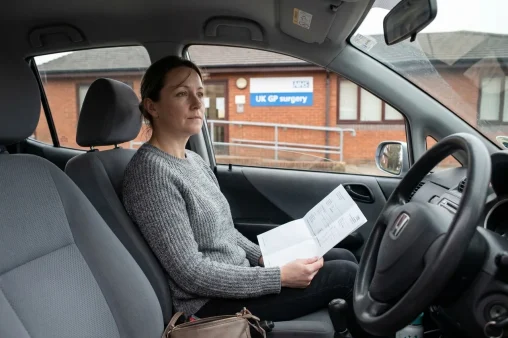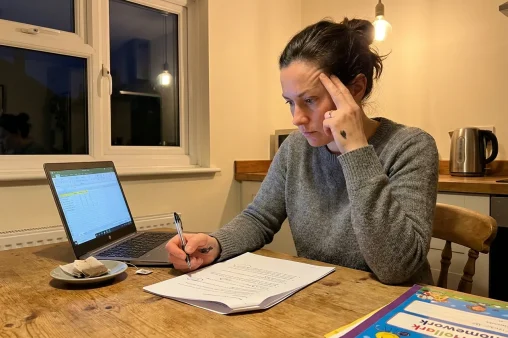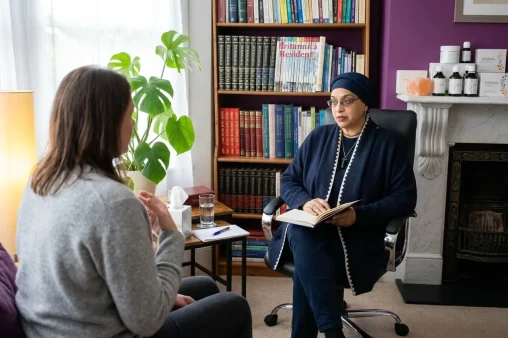

You spent three months with a mindset coach who helped you set genuinely brilliant goals. You left every session feeling clearer. And your migraines still come every Tuesday afternoon, your stomach still cramps before every board meeting, and you still wake at 3am with your heart racing.
Nobody told you this, so I will.
A mindset coach, a therapist, and a holistic root-cause practitioner are not three versions of the same thing. They address completely different layers of the problem.
Coaching works on your conscious thinking. That’s roughly 5% of what drives your behaviour. Therapy processes emotional trauma and clinical conditions at a regulated level. Holistic root-cause practice addresses the physiological dimension, the bit where your body is storing stress that neither coaching conversations nor talking therapy can physically shift. The kind of stress that shows up as fatigue that sleep doesn’t fix, gut problems that flare under pressure, or hormonal disruption nobody can explain.
The right choice depends on where your problem primarily lives. For most high-achievers experiencing burnout alongside persistent physical symptoms, the body is the layer nobody has looked at yet.
I should be upfront. I’m a holistic practitioner who integrates homeopathy, bioenergetic scanning, hypnotherapy, and coaching. So I’m biased.
I also know, from 30 years of sitting across from people, that my approach is not always the right first step. If your challenge is purely strategic and you’re physically well, a mindset coach will get you there faster and more affordably than I will. Three sessions at £200 each and you’re moving. Spending thousands on a healing programme when what you actually need is accountability and a clear plan? That would be a waste of your money and my time.
And if you’re in a psychiatric crisis, if you’re dealing with active suicidal thoughts or severe clinical depression, you need a qualified therapist or psychiatrist. Not me. Not any holistic practitioner. I tell prospective clients this regularly, and I mean it.
This article isn’t for someone who’s already decided and wants validation. It’s for the woman genuinely stuck between three options, typically after one approach has already partially worked but left a gap she can’t quite name. Here’s the short version before we get into the detail.
Key Takeaways
- Coaching, therapy, and holistic practice address different layers of the same problem, not different intensities of the same service.
- A mindset coach is the right first step if you’re physically well and need strategic clarity. Typically £80-£300 per session.
- A therapist is the non-negotiable first step for clinical anxiety, active depression, PTSD, or any condition requiring formal diagnosis.
- A holistic root-cause practitioner fits when physical symptoms persist despite “normal” blood tests and coaching or therapy hasn’t resolved the body dimension.
- The costliest mistake isn’t choosing the wrong approach. It’s cycling through all three as separate services for years without anyone connecting the layers.
Only here for one part of this?
- Want the side-by-side numbers? Jump to the comparison table.
- Already tried coaching but your body still isn’t right? Read the holistic root-cause section.
- Worried your symptoms might be clinical? See when a therapist should come first.
- Wondering if you can combine approaches? Skip to the sequencing section.
What does each approach actually do?
Most women I see have already tried at least one of these three. What nobody’s told them is that each one was built for a different layer. So they’ve been judging an apple by how well it performs as an orange.
Mindset coaching operates on the conscious mind. A good coach helps you clarify goals, reframe limiting beliefs, build accountability, and develop strategic thinking. If you’re stuck because imposter syndrome is paralysing your decisions, or you can’t see the wood for the trees, coaching is brilliant for that.
What it can’t do is shift the 95% running beneath the surface. Your subconscious patterns, your nervous system’s stored stress responses, the hormonal disruption that no amount of positive reframing will override.
A coach can help you think differently about your exhaustion. They can’t physically reset the adrenal system that’s causing it.
And here’s something most people don’t realise. Most mindset coaches hold no clinical training in trauma, physical health, or the nervous system. They’re trained for the thinking layer. If you’re asking them to fix a body problem, you’re asking a brilliant electrician to sort your plumbing.
Therapy goes deeper into the emotional layer. A good therapist trained in Cognitive Behavioural Therapy (CBT) or Eye Movement Desensitisation and Reprocessing (EMDR) can process trauma, regulate emotional responses, and treat clinical conditions within an evidence-based, often regulated framework.
If your suffering has a clinical dimension, therapy offers something no coach or holistic practitioner can. Formal diagnosis. Clinical risk management. NHS or insurance-funded support.
Where therapy often stops is at the body. If your body has been holding onto stress for years, expressing it through migraines, gut problems, hormonal chaos, or fatigue that sleep doesn’t fix, talking about the trauma doesn’t always physically shift what’s been stored.
That’s not a criticism of therapy. It’s a recognition that the body keeps score in ways conversation alone can’t always reach.
Holistic root-cause practice addresses the physical and energetic layer alongside the emotional roots. Think of the body like a motherboard, right? When stress disrupts the programming, the signals aren’t clear any more. You’re still eating, sleeping, going to work. But you know you’re not right.
In my practice, I use bioenergetic scanning to map what’s happening beneath the surface, homeopathy to address the root cause and support the organs that are struggling, hypnotherapy to rewire the subconscious patterns driving the problem, and coaching to give you strategic clarity. It’s not one tool. It’s a toolbox, and I pull out what you need based on what your body is telling me.
The honest limitation? It can’t formally diagnose a clinical condition. It doesn’t replace a GP or a psychiatrist. And the evidence base for specific modalities, bioenergetic scanning included, doesn’t carry the weight of decades of randomised controlled trials behind CBT or EMDR. That’s the truth.
No person in burnout should have to become an expert in three different disciplines just to figure out which one addresses what’s actually happening inside her body. That’s what this comparison is for.
How do they compare on the criteria that actually matter?
Every figure below is based on current UK pricing and publicly available regulatory information. The table gives you the scannable version. The detail follows underneath.
Mindset coaching, therapy, and holistic root-cause practice compared on seven decision-relevant criteria (UK, 2025/26)
| Criterion | Mindset Coaching | Therapy | Holistic Root-Cause Practice |
|---|---|---|---|
| Primary focus | Conscious thought patterns, goal-setting, accountability | Clinical emotional processing, trauma, formal diagnosis | Physiological and energetic imbalances alongside emotional roots |
| Session structure | 60-minute sessions; 6-12 sessions over 2-6 months | 50-60 minutes weekly; blocks of 6-20 sessions | 60-120 minute initial consultation; structured 8-12 week programme |
| UK cost range | £80-£300 per session; packages £600-£6,000 | £50-£150 per session (private); free via NHS Talking Therapies (14-24 week wait) | £2,000-£10,000 over 8-12 weeks |
| Typical timeframe for shifts | 2-6 weeks | 6-12 sessions for measurable psychological improvement | 4-8 weeks for initial shifts; chronic conditions 3-6 months |
| UK regulatory status | “Coach” is not a legally protected title; voluntary ICF or AC accreditation | “Therapist” and “counsellor” are not legally protected titles; BACP/UKCP voluntary registers; only “Clinical Psychologist” and “Counselling Psychologist” are HCPC-protected | “Holistic practitioner” is not a legally protected title; CNHC voluntary register is PSA-accredited |
| Cannot address | Physical symptoms, clinical mental health conditions, physiological stress responses | Physiological burnout symptoms (fatigue, irritable bowel syndrome, hormonal disruption); outcome data tracks psychological recovery only | Formal psychiatric diagnosis, acute psychiatric crisis, medication management |
| Right first step when | Body feels well; primary issue is goal confusion, imposter syndrome, or strategic overwhelm | Clinical anxiety, active depression, PTSD, suicidal ideation, or condition requiring formal diagnosis | Physical symptoms persist despite “normal” tests; coaching or therapy hasn’t resolved the body dimension |
At Rise Radiantly, a standalone RootScan Breakthrough Session is £2,222 and the full 8-week Rooted Radiance Immersion is £9,999. Those sit at the higher end of the holistic range because they bundle scanning, homeopathy, hypnotherapy, and coaching into a single programme rather than charging per session.
One number from that table worth sitting with. NHS Talking Therapies reports a 50.5% recovery rate for people who complete treatment. That’s meaningful for the psychological dimension.
But there’s no equivalent data tracking whether the migraines stopped, the gut settled, or the hormonal disruption resolved alongside the emotional improvement. Nobody’s measuring that.
Now, here’s what I’d tell you to check before you book with anyone in any of these three categories.
For coaches, look for International Coaching Federation (ICF) or Association for Coaching (AC) credentials, but know that “coach” is not a legally protected title in the UK. Anyone can call themselves one tomorrow.
For therapists, check registration with the British Association for Counselling and Psychotherapy (BACP) or the UK Council for Psychotherapy (UKCP). The UKCP itself acknowledges that statutory regulation of psychotherapy titles remains unresolved.
Only “Clinical Psychologist” and “Counselling Psychologist” are legally protected by the Health and Care Professions Council (HCPC). “Therapist,” “counsellor,” and “psychotherapist” are not. Most people don’t know that.
For holistic practitioners, check the Professional Standards Authority (PSA) accredited register list and the Complementary and Natural Healthcare Council. Ask about professional insurance. And ask what they do when someone walks in with something beyond their scope. If the answer is vague, keep looking.
When is a mindset coach genuinely the right first step?
A good mindset coach is your best investment if you’re physically well, your blood tests are fine, you feel fine in your body, and your problem is that you can’t see clearly through competing priorities, imposter syndrome, or career confusion.
Genuinely. Not as a polite concession before I sell you something else.
I’ve met this woman dozens of times. She’s running a business, her body is fine, her sleep is decent, but she’s been so buried in the day-to-day that she can’t see where she’s actually going. She doesn’t need healing. She needs someone to ask her the right questions about what she wants and where she’s headed.
Three sessions with a good coach and she’s made the pricing decision she’d been avoiding for six months. The momentum carries everything else.
A solid executive coach at £150-£300 per session, working over 6-12 sessions, will get her moving faster and more affordably than therapy or holistic work. That’s roughly £900-£3,600 for clarity, accountability, and a strategic plan.
Sending this woman into a multi-thousand-pound healing programme would be overkill for what is fundamentally a thinking problem. I’d rather she spent that money wisely than spent it with me when she doesn’t need to.
Coaching wins when the problem is above the surface. When it’s about how you’re thinking, not what your body is doing underneath.

When is a therapist genuinely the better choice?
If you’re experiencing clinical anxiety that needs formal diagnosis, active depression, suicidal thoughts, PTSD requiring evidence-based protocols, or any kind of psychiatric crisis, you need a regulated, clinically trained professional.
No holistic practitioner should be telling you they can handle that. Including me.
I learned this early. A man with schizophrenia was referred to me for homeopathic treatment. During a session, he became severely distressed, refused to leave my clinic, and started banging his head against the porch wall. I was home alone. It was frightening.
His wife and a friend begged me to continue seeing him afterwards. I refused. Not because I didn’t care about him. Because schizophrenia is a serious psychiatric condition that sits entirely outside the scope of what holistic practice can safely manage. He needed a psychiatrist, not a homeopath.
If you asked me the single most important thing that experience taught me, it’s this. Knowing your boundaries isn’t a limitation. It’s the thing that makes you safe to work with. I won’t treat severe psychiatric conditions, and I will always refer when someone’s presentation is beyond my scope. Any practitioner, in any discipline, who claims they can handle everything without clear referral boundaries? That’s someone I’d encourage you to question.
I’ve referred women to therapists too. Women who came to me presenting with fatigue, but within ten minutes it was clear they were dealing with something clinical. Thoughts they hadn’t told anyone about. Panic attacks that were disabling them.
Grief that had tipped into something darker.
The right thing to do is say, before I do anything here, please speak to your GP this week. Not because I can’t be bothered. Because that’s not my lane, and pretending it is would put her at risk.
Therapy’s evidence base for psychological recovery is real. But there’s a gap worth knowing about.
The Nuffield Trust found that of the 1.8 million people who sought help from NHS Talking Therapies in 2023/24, only about 17% completed a full course of treatment.
And the recovery data that does exist? It tracks psychological outcomes only. Not whether the physical dimension of burnout resolved alongside the emotional improvement. Many clients I see are in precisely this position. Emotionally clearer after therapy. Still physically unwell.
When is a holistic root-cause practitioner the strongest fit?
You’ve done the coaching. You’ve tried therapy. Your thinking is clearer, your emotional awareness has improved.
And your stomach still cramps every morning, your energy crashes by 2pm, your migraines come like clockwork, and your blood tests keep coming back “normal.”
This is the profile I see most often.
The Health and Safety Executive reports 964,000 workers suffering from work-related stress, depression, or anxiety in 2024/25. What that number doesn’t capture is the physical dimension. The chronic fatigue, the gut problems, the hormonal disruption that sits alongside the psychological burden, particularly in women.Deloitte’s Women @ Work survey found 27% of working women report health challenges related to menstruation, menopause, or fertility. These aren’t separate from burnout. They’re intertwined with it.
One of the clearest examples I’ve seen of why an integrated approach matters was a human rights solicitor who came to me through family referrals. From the face front, she was formidable. Fighting cases in court, running a family, holding everything together. Strong. Accomplished. Not someone who falls apart.
From inside, she was crumbling. Hormonal imbalances, concerning health markers, and an emotional weight she’d been carrying for years that nobody had connected to what was happening physically. She was the kind of woman who didn’t want to talk about what was happening beneath the surface, because she was this figure. And figures don’t fall apart.
We started with homeopathy, addressing what her body had been storing. Then coaching. Giving her the strategic clarity and courage to act on what the healing was unlocking. Over the weeks, something shifted. Not just her symptoms. Her entire relationship with her life changed. What I taught her, she brought into her family. She taught her husband and her children the same tools. The dynamics at home changed alongside the physical healing.
She ended up relocating her family to another country entirely. She told me it was the coaching that gave her the courage to take that step.
But here’s the insight she’d pass to any woman in the same position. Without the homeopathy addressing what her body had been holding, the coaching would have been pushing against a wall. If she’d just gone to a coach, she’d still be in pain. If she’d just done the remedies, she might not have found the courage. It was both together.
That’s the difference. And it’s a big one.
Where my approach falls short
The evidence base for specific modalities within holistic practice doesn’t carry the weight of large-scale randomised controlled trials the way CBT does. Bioenergetic scanning is not a medical diagnostic tool. It maps energetic imbalances, not diseases.
If you need a formal diagnosis for your employer, insurer, or GP, I can’t provide that.
And some chronic conditions with 15-20 years of medication layers respond more slowly and less predictably than others. Eight weeks won’t undo two decades of accumulated imbalance for everyone. I wish it could.
When holistic root-cause work is not the right choice
I want to be direct about this, because plenty of practitioners won’t be.
Holistic root-cause work is not the right choice if you need a medical diagnosis. I can’t give you one. If your GP hasn’t investigated your symptoms yet, go there first. Rule out anything serious before you come to me.
It’s not the right choice if you’re in a psychiatric crisis. Severe depression, psychosis, active suicidal thoughts. Those need clinical intervention, not remedies and breathwork.
It’s not the right choice if you want someone to fix you without your involvement. There’s no magic pill. There is a magic process, but it requires you to show up for it. I give you remedies, homework, practices. If you’re not going to take them, do them, and show up between sessions, you won’t get results. That’s not my approach failing. It’s the partnership not being there.
And it’s not the right choice if your problem is genuinely above the surface. If you’re physically well and mentally stuck, a coach at £200 a session will sort you out faster and cheaper than anything I offer. I mean that.

Can these approaches work together instead of competing?
You don’t have to pick one and stick with it forever. These approaches can work in sequence, each addressing the layer that’s most acute at that moment.
One woman came to me after 18 years of cycling through GPs, naturopaths, other homeopaths, and nutritionists for a persistent digestive condition. She’d spent thousands. Each practitioner helped temporarily. Then the symptoms came back.
None of them asked the question that changed everything. When I took her back to where it started, 18 years earlier, she’d experienced an emotional shock in Singapore. Something she’d found, quite literally, hard to digest. Nobody before me had connected that shock to the physical symptom it was producing. Once we addressed both together, the condition resolved in weeks.
Eighteen years. And the missing piece was one question nobody thought to ask.
The biggest pattern I see in my practice matches what the wider data shows. The CIPD’s Health and Wellbeing at Work 2025 report documents that burnout persists despite workplace interventions, and that services remain fragmented and siloed. Women are left coordinating their own recovery across practitioners who don’t communicate with each other.
A realistic sequence might work like this. If acute mental health needs stabilising first, start with a therapist to build the emotional container. Once you’re stable, move into holistic root-cause work to address what the body has been holding. Once the body is regulated, a mindset coach can maintain momentum and prevent the patterns recurring.
If you want the full picture on burnout recovery across all these approaches, our burnout and chronic fatigue articles cover the complete landscape.
The real mistake isn’t choosing the wrong one. It’s spending years cycling through single-modality practitioners who each address one layer while the others remain untouched.
So which one do I actually need?
Three questions. Answer them honestly.
Are you physically well? If your energy is stable, your body feels fine, your sleep is decent, and your challenge is primarily about clarity, direction, or confidence, start with a mindset coach. You’ll get results faster and spend less.
Are you in clinical distress? If you’re experiencing suicidal thoughts, severe depression, panic attacks that are disabling you, or symptoms that need formal psychiatric assessment, see a therapist or your GP first. And if something is sudden and severe, a new thunderclap headache, unexplained weight loss, new neurological changes, that needs urgent medical attention, not a holistic practitioner.
Are your physical symptoms persisting despite coaching or therapy? If your blood tests are “normal,” your therapist has helped your thinking, but your body still isn’t right, you’re likely dealing with stored stress that neither conscious reframing nor emotional processing can physically shift. That’s where root-cause work comes in. Looking at the emotional origin and the physiological expression at the same time.
If you answered yes to the third question, that’s the profile I work with every day. If you’re now weighing up holistic practitioners, our guide to the best holistic practitioners for burnout recovery in the UK gives you names and criteria to work from.
Every month spent going back and forth between these three options is another month your body continues compensating for stress it wasn’t designed to carry indefinitely. The cost of choosing wrong isn’t just the fee. It’s the years of partial relief that keep you just well enough to keep going but never well enough to thrive.
If you’re still working out which approach fits, come back to the three questions above. They’re the simplest decision framework I know.
And if you recognised yourself in that third question, if physical symptoms nobody can explain sit alongside emotional roots you suspect but nobody has investigated together, a free 30-minute health audit is the simplest way to find out whether my approach fits your specific situation. You ask “can you help me?” and I give you an honest answer.
If you already know you want someone to look at the whole picture, see what the RootScan Breakthrough Session includes.
And if you identified with the coaching or therapy profile? Good. I hope this article gave you the clarity to commit to that path with confidence. You don’t need me. You need the right person for where your problem actually lives.
Sameena Khan
Founder, Rise Radiantly
Frequently Asked Questions
Can I see a mindset coach and a holistic practitioner at the same time?
Yes. And sometimes that’s the strongest approach. I work alongside coaches and therapists regularly. The key is making sure everyone knows what the other is doing so treatments complement rather than overwhelm the process.
How do I check whether my therapist is properly qualified?
Don’t rely on the title. “Therapist,” “counsellor,” and “psychotherapist” are not legally protected titles in the UK. Anyone can use them without specific training.
Check whether they’re registered with the BACP, UKCP, or the HCPC. The Professional Standards Authority maintains a searchable list of accredited registers. If the person you’re considering isn’t on one of those, ask them why.
Why is a holistic programme so much more expensive than individual therapy sessions?
You’re comparing a single session against a multi-week programme combining several modalities. If you saw a separate homeopath, hypnotherapist, scanner, and coach individually over the same period, the combined cost would typically exceed the programme fee. And nobody would be connecting the dots between the four approaches.
Our full comparison of one integrated practitioner versus multiple specialists breaks this down in detail.
What if I’m on medication?
I never take anyone off their medication. Ever. I work around what you’re already taking, supporting your body alongside conventional treatment. Any change to medication is a conversation between you and your GP. Not me.
I tried homeopathy before and nothing happened. Why would this be different?
Not all homeopaths work the same way, right? Some prescribe a remedy and send you home.
I take a full case from birth to now, use bioenergetic scanning to see what’s happening beneath the surface, and layer in hypnotherapy and coaching alongside the remedies. If the previous homeopath didn’t connect the emotional root to the physical symptom, the remedy was only ever treating part of the picture. You need someone who’s looking at the whole thing.
If anything here made you think “that sounds like me,” let’s have a conversation and figure out whether I can help.