
If the machine is the same, why does one bioenergetic scan cost £85 and another cost over £2,000?
A bioenergetic scan in the UK runs anywhere from £85 for a basic food intolerance screening to £2,500 or more for a comprehensive root cause session with bespoke remedies, a strategy session, and structured follow-up. That’s roughly a 25x spread. And the reason it varies so wildly is that you’re not paying for the machine. You’re paying for what the practitioner does with the data it produces, what they wrap around it, and whether you walk away with a printout or a plan.
I run a bioenergetic scanning practice, and my RootScan Breakthrough Session sits at £2,222. Firmly at the premium end. So yes, I’ve got a stake in this conversation.
But I also know my scan isn’t the right fit for everyone. And I’d rather you understood the full picture before spending a penny with anyone.
Here’s the short version before I walk you through the detail.
Key Takeaways
- Bioenergetic scans cost £85 to £2,500+ in the UK. The price spread is about the practitioner, not the machine. Often the exact same Qest4 device sits across the entire range.
- Cheaper scans often cost more long-term. A £95 scan plus £100 a month in supplements hits £1,295 in a year, and nobody’s touched the root cause.
- My RootScan sits at £2,222. Remedies, strategy session, follow-up, and direct access included. Not everyone needs this level. I’ll tell you if you don’t.
Not sure which part matters most for your situation?
- Just want the price breakdown? Jump to the three-tier comparison.
- Wondering why some scans cost twenty times more than others? See what actually drives the price up.
- Worried about costs that don’t appear on the price list? Read about hidden costs.
- Think a cheaper scan might be fine for you? Find out when it genuinely is.
What is a bioenergetic scan and what does it actually measure?
A bioenergetic scan uses a device, typically a Qest4, NES Health, or similar system, to send frequency-based signals to the body and measure what comes back. Think of it like this. Your body has a motherboard, right? It’s running your systems, keeping everything ticking. The scan is checking where the signal is clear and where it’s not.
What it picks up are energetic imbalances, not medical diagnoses. I’ll come back to that distinction because it matters.
Here’s the thing most people don’t realise.
The Qest4 machine in a practice charging £89 is often the exact same piece of equipment as the one in a practice charging £2,000+. Qest4 Global, who manufacture the system from Hampshire, market it to homeopaths, nutritional therapists, kinesiologists and health coaches alike.
Same machine. Same software. Same database of thousands of signatures.
What creates the price difference is everything the practitioner brings around it.
How much do bioenergetic scans cost in the UK?
Bioenergetic scan pricing in the UK in 2026 falls into three distinct tiers. Each one serves a different purpose, and understanding what’s included at each level is the key to choosing well.
My own RootScan sits at the comprehensive end at £2,222, but the market starts much lower. And for some people, lower is exactly the right place to be.
Tier 1. Basic and data-led (£85 to £175)
A 30-to-60-minute session. The scan runs, you leave with a data printout listing food sensitivities, deficiencies, or environmental triggers. Minimal interpretation. No case history. No remedies included.
Supplements are recommended but bought separately.
Best for someone who wants a general wellness screen or a food intolerance list and is comfortable working with the data themselves. What you sacrifice is any investigation into why those imbalances exist in the first place.
UK examples include the Allergy-Homeopath at £89 for adults and Zenergetics at £97 for a 30-minute test-only session.
Tier 2. Mid-range (£175 to £350)
A 60-to-90-minute session with more practitioner interpretation. You may get a short written plan or nutritional recommendations. Supplements still typically purchased separately.
Best for someone who wants more context around their results but doesn’t need a deep-dive root cause investigation. What you sacrifice is integrated case history, emotional timeline analysis, bespoke remedies, and structured follow-up.
UK examples include Zenergetics at £197 for a one-hour test with full report and Carley Harrison at £165 for an initial session.
Tier 3. Comprehensive root cause programme (£1,500 to £2,500+)
This is a fundamentally different service. It bundles the scan with an in-depth case history, detailed practitioner interpretation through a specific clinical lens, bespoke remedies, a structured action plan, and scheduled follow-up support.
Session lengths run 60 to 120 minutes or more, plus follow-up appointments.
Best for someone with chronic, complex, or unexplained symptoms who wants to understand the why behind their imbalances. Not just what’s showing up, but when it started and what triggered it.
My RootScan Breakthrough Session sits at £2,222 at this tier. Functional Nexus offers comparable programmes at £1,975 to £2,495.
| Criterion | Basic (£85 to £175) | Mid-range (£175 to £350) | Comprehensive (£1,500 to £2,500+) |
|---|---|---|---|
| Session length | 30 to 60 minutes | 60 to 90 minutes | 60 to 120+ minutes |
| Case history taken | No | Limited | Full, from birth to now |
| Remedies included | No | No | Typically yes |
| Supplements | Bought separately | Bought separately | Often included or specifically guided |
| Follow-up | None | Minimal | Scheduled calls and practitioner access |
| Root cause investigation | No | Limited | Yes |
| Best for | Food intolerance list, general wellness check | More context around scan results | Chronic, complex, or unexplained conditions |
What pushes the price of a bioenergetic scan higher?
Right, so what are you actually paying more for?
When I went to Utah for the Qest4 training, I looked around the room and it hit me. Every single person in that training would walk out interpreting the same scan data in a completely different way.
I was the only homeopath. The rest were psychiatrists, nutritionists, kinesiologists, biohackers.
A nutritionist looks at that data and sees deficiencies. Recommends supplements. I look at the same data and see a root cause map. I’m asking, when did this imbalance start? What shock might have triggered it? How has the body been compensating ever since?
Same machine. Same data. Completely different service.
That practitioner variation is the single biggest thing pushing the price up, adding £500 to £1,500 in value depending on the depth of their clinical background and experience. But three other variables stack on top of it.
Bespoke remedies included (adds £100 to £300). At the premium end, remedies are mixed by the practitioner and included in the price. At the budget end, you leave with a shopping list to fill yourself.
Integrated case-taking and emotional timeline (adds £200 to £500). The scan gives data. The case history gives the story behind that data. Without both, you’re reading the answer without understanding the question.
Depth of follow-up support (adds £200 to £600). Action plans, follow-up calls, practitioner access between sessions. At the comprehensive tier, the relationship continues after you leave the room. At the basic tier, it ends when you walk out the door.

What brings the cost of a bioenergetic scan down, and what do you sacrifice?
So how do you bring the price down? You can. But here’s what you give up.
Limiting the scan to food intolerance testing only (saves £500+). If all you want is a list of what your body reacts to, a basic scan or even a food intolerance blood test will give you that.
YorkTest offers a Premium Food Intolerance Test at £139 (sale price as of early 2026; list price £199) screening IgG (Immunoglobulin G) antibody reactions to 200 foods.
Worth knowing, though, that Guts UK states there isn’t strong evidence IgG tests accurately identify a food intolerance. I mention them as a price reference point, not a clinical recommendation.
What you sacrifice is any investigation into why you’re intolerant in the first place.
Skipping the full case history (saves £200 to £400). The scan runs. You get results. But those results are interpreted without knowing your emotional history, your lifestyle, or when symptoms started.
It’s like reading someone’s blood pressure without knowing they’ve just had a row with their boss. The number is accurate. The interpretation is incomplete.
Buying supplements separately instead of receiving included remedies (saves £100 to £300 upfront). This is where it gets interesting.
One of my existing homeopathy patients went to another practitioner for a bioenergetic scan. She didn’t know I offered one. She paid for what turned out to be a straightforward intolerance-type test.
She walked away with four or five different supplements but no understanding of why her body was out of balance. No one had taken her history. No one had asked when it started. No one had dug into any of it.
Supplements will help, yes. But you want to understand why your body is asking for them in the first place. That upfront saving can quietly turn into £50 to £150 a month in supplements that manage imbalances without ever getting to the root.
Why do some bioenergetic scan practitioners charge so much more?
When people see a scan priced at £2,000, the first thought is usually that has to be a rip-off. I understand that.
But let me challenge it. Because the price difference isn’t about greed. It’s about what happens when you’re not in the room.
At a comprehensive practice, your appointment isn’t the whole story. After you leave, the practitioner spends time analysing your case, cross-referencing scan data against your history, writing a detailed report, and formulating a protocol tailored to you.
That non-contact work often takes as long as the session itself. You never see it on the appointment schedule, but it’s built into the price. You’re paying for the thinking, not just the talking.
Then there’s accountability. Registration with professional bodies such as the Complementary and Natural Healthcare Council or the Federation of Holistic Therapists signals that the practitioner operates under a code of conduct and carries insurance.
It doesn’t guarantee brilliance. But it means someone is watching.
So if you’re trying to work out whether a premium practitioner is worth the price, ask two questions.
First, what happens after the scan? If the answer is “you get a printout and off you go,” the price isn’t justified regardless of how high or low it is.
Second, how long have they been practising, and through what clinical lens do they interpret the results? Qualifications plus decades of active case-taking experience is a different proposition to someone who completed a weekend device course.
Why are some bioenergetic scans so cheap?
I’m not going to sit here and tell you an £89 scan is a waste of money. For some people, it’s exactly the right choice.
If you want a basic food sensitivity screen and you’re comfortable interpreting the data yourself, a budget scan gives you that.
The risk isn’t in the cheap scan itself. The risk is in the mismatch.
When someone with chronic fatigue, unexplained symptoms, or a condition their GP hasn’t been able to pin down books a basic scan expecting answers, they’re in the wrong tier. They walk away with a list of things to avoid and bottles to buy. The data might be technically accurate, but without context it’s incomplete. Nobody asked when the symptoms started. Nobody explored what was happening in their life at that point. Nobody connected the dots.
The Advertising Standards Authority has previously found that bio-resonance testing claims about diagnosing sensitivities were unsubstantiated. That ruling tells you something important.
The machine alone doesn’t give you answers. The practitioner’s ability to interpret, contextualise, and build a protocol around the data is where the value sits.
If you’ve got complex symptoms, a basic scan at any price isn’t the starting point. It’s the wrong tool for the job.
What hidden costs should I watch for when booking a bioenergetic scan?
Two costs that rarely appear on the price list. And this is the bit that frustrates me, because it means the “cheap” option is often not cheap at all.
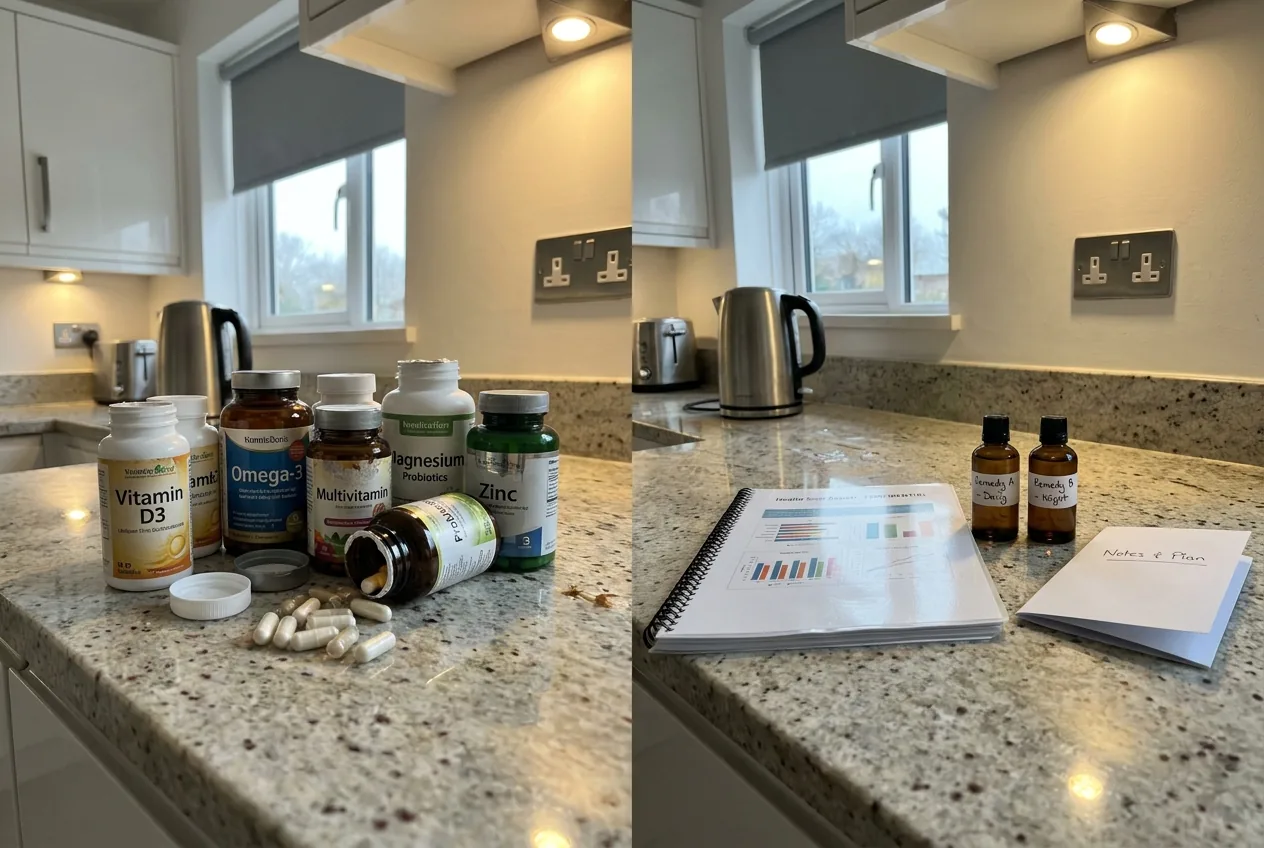
Ongoing supplement bills. A basic scan typically results in supplement recommendations you purchase independently. Based on typical practitioner-recommended supplement pricing in the UK, that runs £50 to £150 per month.
So a £95 scan can quietly generate £600 to £1,800 in annual supplement costs. And you still won’t know why your body needed them.
You can cut the weeds and the garden looks nice and clean. But until you pull them out from the roots, they’re going to keep on growing.
Supplements without root cause investigation are weed-cutting. The imbalances stay. The bill keeps coming.
| Basic scan | Mid-tier scan | Comprehensive (Rise Radiantly example) | |
|---|---|---|---|
| Upfront cost | £95 | £250 | £2,222 |
| Monthly supplements | Roughly £100 | Roughly £50 | Roughly £75 (from month 2) |
| 12-month total | Roughly £1,295 | Roughly £850 | Roughly £3,047 |
I’ll be straight with you. The comprehensive option is still the most expensive over twelve months. That table doesn’t hide it. The difference is that at the comprehensive tier, the practitioner is investigating the root cause with the aim that supplements reduce over time rather than continuing indefinitely.
Repeat scanning. When an initial scan doesn’t include root cause investigation, people frequently come back for another scan, or go looking for a different practitioner entirely, within six months. Each time, the clock and the bill reset.
There’s something genuinely wrong with a market where you can’t tell whether you’re paying for a premium service or a premium label. That’s exactly why I’m writing this.
Where does Rise Radiantly’s RootScan pricing fall, and what is included?
My RootScan Breakthrough Session is priced at £2,222, or two payments of £1,111. It sits at the top of the comprehensive tier. Here’s exactly what that includes.
A full bioenergetic scan. A 90-minute interpretation and strategy session, which is me sitting with you, going through everything the scan is showing, connecting the data to your history, explaining the why behind what’s coming up.
Bespoke homeopathic remedies I mix myself from 30 years of clinical experience, covering the first four to six weeks. An energy blueprint report translated into plain language so you actually understand it.
A Leadership Energy Action Plan with 7-day, 14-day, and 30-day action sprints. A follow-up integration call within 10 to 15 days to check how you’re getting on. And two weeks of priority WhatsApp access to me directly.
The scan itself represents roughly 30% of that total value. The remaining 70% is everything I bring around it.
A complete stranger rang me recently. She’d been referred by someone for a homeopathy appointment. I said, “Look, I can do a scan as well, which will include the homeopathy. Let’s get a fuller picture of what’s going on.”
She came in. I did the scan, included the homeopathic consultation, and gave her five minutes of hypnotherapy at the end because her head was heavy with stress.
When she came out, she said, “My head feels lighter. That was amazing.”
I called her a few days later. She’d already booked her sister in for a scan the following week.
Nobody asked her to.
Now, the honest limitations. At £2,222, this isn’t accessible for everyone. If you simply want a food intolerance list, it’s genuinely more depth and investment than you need. I’d rather you knew that upfront than found out after paying.
And I should be upfront about something else. There are no published clinical trials comparing comprehensive bioenergetic scanning to any other health intervention. None. Not for the comprehensive tier, not for the basic tier.
The evidence base for this approach is 30 years of clinical practice, thousands of client outcomes, and the regulatory framework that classifies these devices as wellness tools, not medical devices.
If you need the reassurance of peer-reviewed data before investing, that data doesn’t exist for bioenergetic scanning at any price point. I’d rather tell you that honestly than have you discover it afterwards.
When is a cheaper bioenergetic scan genuinely the right choice?
A basic scan or a food intolerance blood test is the right call when you only want a sensitivity list and you’re comfortable working with the data yourself. Or when you’re monitoring general wellness without chronic or complex symptoms. Or when you’ve already been through comprehensive investigation and just need a check-in.
A bioenergetic scan at any price isn’t the right investment if you want a confirmed medical diagnosis. No scanner provides this, and the ASA is clear that bioenergetic devices are wellness tools, not diagnostic equipment. See your GP first.
It’s also not the right fit if you’re experiencing clinical red flags that need urgent medical attention. A&E first. Always.
And if you’re not willing to discuss your emotional and personal history alongside physical symptoms, paying for a comprehensive scan while withholding information is money wasted. The more honest you are, the better I’m able to help you. The depth of the results depends entirely on the honesty of the conversation.
Is a bioenergetic scan worth the investment?
That depends on what you’re investing in.
If you’ve got mild, non-urgent symptoms and you want a general wellness screen, a basic scan at £85 to £175 gives you data proportionate to the need. You don’t need the comprehensive approach for that.
If you’ve got chronic or unexplained symptoms, the kind where your GP says “everything’s normal” but you know something isn’t right, the question changes.
It’s no longer “Is £2,000 a lot for a scan?” It’s “How much have I already spent on appointments, supplements, and practitioners who haven’t got to the bottom of it?”
Do the maths. If you’ve been spending £100 a month on supplements for two years without anyone asking why your body needs them, that’s £2,400 you’ve already invested without anyone getting to the root.
The supplements keep coming because the imbalance is still there. You’re managing it, not resolving it. That’s the real cost of staying where you are.
If you need to explain this investment to someone at home, the 12-month cost comparison table above is the conversation starter. The question for both of you isn’t “Why would you spend £2,000?” It’s “What are we already spending every month that isn’t getting us anywhere, and what would it mean to actually get to the bottom of it?”
Here’s what you can do right now, regardless of which tier you choose. Match your symptoms to the tier table earlier in this article. Ask any practitioner what’s included in their price, specifically whether remedies, case-taking, and follow-up are bundled or separate.
Work out the 12-month total including supplement costs, not just the headline session price. And if you’ve got chronic or complex symptoms, confirm the practitioner takes a full case history before running the scan. If they don’t, you’re in the wrong tier.
You now know what each price level includes, what gets stripped out when the price drops, and what to watch for. You can walk into any conversation with any practitioner and ask the questions that matter. That’s a genuinely different position from where you started.
If you want to understand more about what a comprehensive scan involves before speaking to anyone, this page walks through the full RootScan process.
If you’re still unsure which level fits your situation, book a free 30-minute health audit and let’s figure it out together. No obligation. No pressure. And if a basic scan or a blood test turns out to be the right starting point for you, I’ll tell you that too.
Sameena Aziz Khan
Rise Radiantly
Frequently asked questions
Does a bioenergetic scan provide a medical diagnosis?
No. It picks up energetic imbalances. It’s not a medical diagnostic tool, and no practitioner using a Qest4, NES, or similar system can legally or ethically diagnose a medical condition. If you need a diagnosis, see your GP first. That’s always the starting point for anything serious.
Can I do a bioenergetic scan remotely?
Yes. People ask me, “How can you do a scan just from my name and date of birth?” And I say, how do you make a phone call? You dial a unique number. Your name and date of birth is unique to you. That’s all I need. Some practitioners also accept a hair sample. Remote scanning means you get the same depth of service wherever you are.
Are remedies included in the price or do I pay separately?
This varies enormously, and it’s one of the most important things to ask before you book. At the basic tier, you almost always leave with a list of supplements to purchase independently. At the comprehensive tier, bespoke remedies are typically included. Always ask. It makes a real difference to your total cost.
How does a bioenergetic scan compare to a food intolerance blood test?
A food intolerance blood test like YorkTest at £139 measures IgG antibody responses to specific foods. A bioenergetic scan measures a broader range of energetic responses across the body’s systems.
If you only want a food intolerance list, the blood test is cheaper and more targeted. If you want a wider picture including energetic, emotional, and systemic imbalances, that’s where a scan offers something a blood test can’t.
Still weighing it up? A free 30-minute health audit is the quickest way to figure out which level fits your situation. And if it turns out you don’t need what I offer, I’ll point you in the right direction.