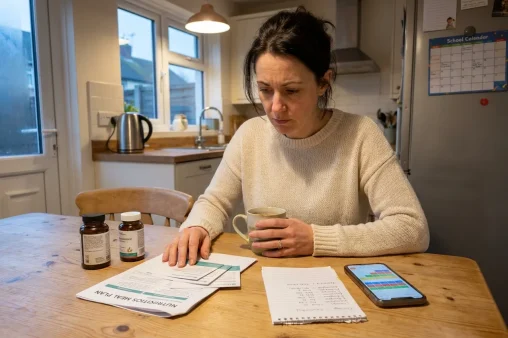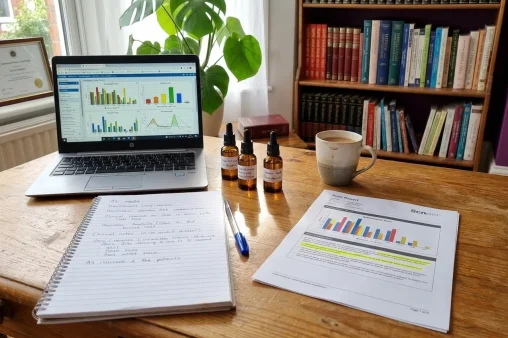

You’ve been scrolling through this website for the last twenty minutes. You’ve read the programme descriptions, seen the £9,999 figure, and your stomach tightened.
Not because you can’t afford it. Because you’ve already spent thousands on a functional medicine clinic that helped temporarily, a burnout coach who addressed your thinking but not your body, maybe a nutritionist before that. And the question you keep circling back to is the one no testimonials page ever answers honestly. Will this actually be different for me, or am I about to add another line to the list of things that didn’t last?
Here’s my honest answer. Rise Radiantly produces its strongest results for women aged 35 to 55 who’ve already spent years, and typically £15,000 to £30,000 based on what people report at intake, across GPs, private specialists, naturopaths, other homeopaths and coaches without lasting resolution. If your blood tests keep coming back “within range” while you feel anything but, and you’re ready to commit 3 to 5 hours a week for eight weeks to an integrated protocol combining bioenergetic scanning, homeopathy, hypnotherapy and coaching, this approach was built for exactly your situation.
But I won’t pretend it’s right for everyone. It isn’t. I’d rather lose a potential client at this stage than take someone’s money when I know the fit isn’t there.
And I should tell you something else right now. If you’ve been on medication for 15 or 20 years, eight weeks won’t undo two decades.
Some chronic conditions with deep medication layers show only moderate improvement in the initial programme. Full resolution can take additional months of maintenance. That’s the honest timeline.
Most practitioners would bury that in paragraph forty. I’m putting it here.
Here’s the short version.
Key Takeaways
- The clients who get the strongest results have already tried multiple practitioners without lasting change. That pattern of temporary relief followed by symptoms coming right back? That’s exactly what the root cause approach is designed to break.
- This requires 3 to 5 hours per week of your active participation. Remedies, journaling, breathwork, emotional honesty. People who treat it as a passive fix consistently see the weakest outcomes.
- Long-standing conditions with medication layers take longer than eight weeks. Moderate improvement is realistic within the programme. Full resolution often needs additional months.
- Non-compliance is the most consistent reason for underwhelming results across 30 years of practice. Not methodology failure.
- If you need a medical diagnosis, want one symptom treated in isolation, or aren’t willing to explore emotional history, a different practitioner will serve you better. And I’ll name them.
Not sure which part applies to your situation?
- Already know you’re a fit and want to see the honest downsides? Jump to what clients find challenging.
- Want to check whether your specific situation is a bad match? See who this is NOT for.
- Weighing up the money? Read the investment comparison.
Who gets the strongest results from Rise Radiantly?
The client who get the strongest results? They’re not the ones with the simplest problems. I’ve been sitting across from clients like you for 30 years, and the pattern I see most clearly is this. They’re the ones who’ve been everywhere else first.
They’ve typically between 35 and 55. A solicitor, a founder, a senior consultant. From the face front, they’re a strong person. Hitting targets, running a business, fighting cases in court. But from inside? They’re crumbling.
Fatigued by 2pm. Anxious in ways she can’t explain to her GP. Digestive issues. Migraines. Hormonal chaos. Blood tests that keep coming back “within range” while she knows something fundamental isn’t right.
According to Health Survey for England data, 48% of women have at least one longstanding condition. Many of them are managing, not resolving. That’s the gap this work fills.
There are two ways people find me. The first is health-driven. They’ve got a diagnosis, thyroid, irritable bowel syndrome (IBS), anxiety disorder, hormonal imbalance, and conventional treatment isn’t getting to the bottom of it.
The second is transformation-driven. She don’t have a label, but they know something’s wrong. They’ve been running on empty and can feel herself approaching the edge.
One woman came to me in that second state. She was in an oppressive relationship, suffering chronic fatigue, aches and pain that no one could explain. Strong on the outside. The kind of woman who keeps the household running, keeps showing up, keeps performing.
But inside she was barely holding on. And her body was keeping score of everything she couldn’t say out loud.
When she sat across from me, I could see the disconnect immediately. Here was someone who looked composed, who was functioning, but whose body was telling a completely different story. Chronic fatigue, constant aches, pain that moved around her body without any clear medical explanation. So I did what I always do. I went back through her timeline. And all of it linked to years of emotional suppression and abuse she’d never been given permission to name.
I treated the root causes. Not just the physical symptoms, but the emotional weight driving them. Gradually, alongside the remedies, something else shifted. Her confidence rebuilt. The woman who’d walked in barely able to advocate for herself began to stand differently, speak differently, make decisions she’d been too depleted to face. She found the courage to change her situation entirely.
Afterwards, she told me, “I came to you crawling. You made me walk again.”
That’s not a quick fix. That’s what happens when someone finally addresses the root instead of cutting the weeds at the top. And when someone heals at that level, the ripple goes beyond them. Families feel the shift. They always do.
What do clients find challenging about working with Rise Radiantly?
Three things are genuinely hard about this work. Reaching me between sessions, the emotional intensity of going back through your timeline, and the honest timeline for chronic conditions. I could fill this section with success stories instead. But that’s not what you need right now, is it?
Reaching me between sessions has been a real frustration
I’m a solo practitioner. When I’m with someone, I’m fully with them. Which means I’m not picking up the phone.
If you need support at 9pm on a Wednesday and I’m not checking messages until Thursday morning, you’ll feel that gap. For programme clients, I’ve addressed this with SOS WhatsApp access and prioritised voice notes. You leave me a message, I get back to you within 24 hours.
It’s not 24/7 availability. I won’t pretend it is. But it means you’re never left hanging for days without a response.
The emotional intensity catches people off guard
When we go back through your timeline, and I mean right back, sometimes 10, 20, 30 years, things surface that you haven’t thought about in decades. Memories. Emotions. Connections between what happened in your past and what your body is doing right now.
Before I say this, don’t beat yourself up, and it’s not your fault because you didn’t know no different. But root cause work means sitting with uncomfortable truths. Some women tell me things they’ve never told another person in their life.
That depth is exactly what makes this work. It’s also the part that feels hardest.

Deep medication layers mean the programme is sometimes the beginning, not the end
If you’ve been on Levothyroxine for four years and an SSRI for two, the programme addresses root causes and supports your body in recalibrating. In my experience, every person who commits fully sees some shift.
The limitation is speed and degree, not whether change happens at all. But for some women, full resolution requires maintenance sessions at £1,111 per month beyond the initial eight weeks.
I’d rather you know that now than find out at week six.
Who is Rise Radiantly NOT a good fit for?
Six specific situations mean this programme is the wrong choice for you. This is the section most practitioners would never publish. I’m publishing it because you’ve already spent money on people who told you what you wanted to hear.
You want a single symptom treated and nothing else
If you sit across from me and say “just deal with my digestion, I don’t want to talk about my periods or my emotions,” you’re in the wrong place. When one clock doesn’t work, it has a knock-on effect on everything else. I need to see the whole picture.
If focused single-modality treatment is what you’re after, a respected homeopath like Hilary Dorrian can help at a lower price point.
You expect a passive fix
The programme requires 3 to 5 hours a week of your active participation. Taking remedies on schedule, doing the journaling, doing the breathwork, being honest about what’s going on emotionally.
If you want someone to fix you while you carry on exactly as before, this isn’t going to work. There’s no magic pill. There is a magic process, but only if you’re willing to be part of it.
You’re looking for a medical diagnosis from the scan
The bioenergetic scan is not a medical diagnostic tool. It doesn’t replace blood tests, MRIs or specialist investigations. The Advertising Standards Authority is clear that health claims need proper substantiation, and I won’t make claims I can’t back up.
The scan identifies energetic imbalances. It’s one input in a broader picture, not a definitive diagnosis. If you need a diagnosis, see your GP first.
You have severe psychiatric conditions
Active psychosis, acute suicidal depression, unstable bipolar disorder. These require specialist mental health services. NHS England’s guidance is clear on this.
An eight-week holistic programme isn’t the right intervention for those conditions. I hold that boundary firmly.
You’re primarily seeking the cheapest option
At £9,999, this programme isn’t price-competitive with a standalone homeopath at £80 to £200 a session. If your primary issue is dietary and budget matters most, a nutritionist like Malika Guechoul may serve you better.
This programme costs what it costs because it integrates four modalities into one coordinated protocol. If that’s more than your situation requires, I’d rather point you to someone who fits.
You’re not willing to be honest about your emotional history
If you withhold information about past trauma, about what’s happening in your relationships, about medication you’re taking, I’m working with an incomplete map.
I’m not here to judge you. I’ve sat across from people with histories that would shock most practitioners. But I can’t find the root if you won’t let me dig.
How to evaluate any holistic practitioner, not just me
Before you invest in anyone, ask these five questions.
- How do they investigate your history? If they don’t ask about your past, your emotions and your full timeline, they’re treating the tip of the iceberg. A good practitioner goes back.
- What happens when results are slower than expected? Ask specifically. “We’ll adjust” is vague. You want a concrete answer with a concrete commitment.
- Who do they turn away? A practitioner who says they can help everyone is either naive or selling you something. The ones who define their limitations are the ones who know what they’re doing.
- Do they work alongside your GP? Anyone who tells you to stop medication without your doctor’s input is a red flag. Full stop.
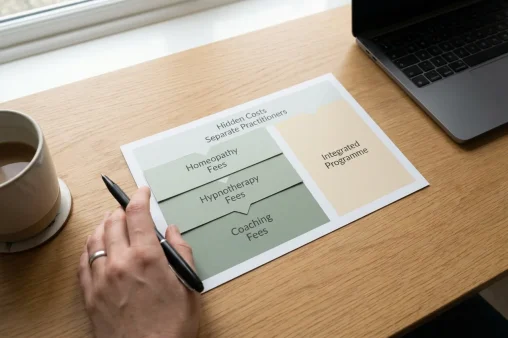
- What’s the total cost, including follow-ups, supplements and maintenance? Hidden costs are common in this space. Get the full picture before you commit.
Those questions work for evaluating anyone. Including me. For a deeper framework, our guide on how to choose between holistic practitioners covers the criteria that separate competent from exceptional.
What happens when results are slower than expected?
Here’s what most practitioners won’t tell you. The most common reason for underwhelming results isn’t methodology failure. It’s the person who starts with every intention of doing the work, and then life gets busy.
I’ve seen this pattern for 30 years. They take the remedies inconsistently, skips the journaling after the first fortnight, doesn’t do the breathwork. Six weeks in, they’ve still got half a bottle of remedy left, a four-week supply barely touched, and they say “it’s not working.”
So I go through my notes with her. The gaps become obvious.
Then we reset. I go through what they’ve missed, adjust the protocol to make it simpler to stick with, and we agree on a check-in halfway through the next month. When they actually takes the remedies consistently and does the breathwork daily, things start to shift within a fortnight.
Not every client recommits at that point. Some decide the process isn’t for them, and I respect that. But the ones who do? The shift is almost always there waiting.
This isn’t me blaming anyone. It’s a reality across all therapy types. NHS Talking Therapies data shows over 40% of people don’t complete treatment in the UK. Homework engagement is one of the strongest predictors of whether someone improves. That’s not unique to what I do.
The Double Down Guarantee
If you follow the protocol, take the remedies as prescribed, do the work between sessions, show up honestly, and results are still slower than expected, I provide additional sessions and remedies at no extra charge.
This isn’t a money-back guarantee. The financial risk sits with you. But it’s my commitment that if you do your part, I won’t stop until we find what we’re looking for. If you hang with me, I’m going to find that root for you.
You should also know that UK consumer law protects you regardless. If a service isn’t delivered with reasonable care and skill, you’ve got legal rights to have it put right, whatever any contract says. That protection exists whether I mention it or not. I’d rather you know.
When the fit isn’t right from the start
I’ve also had someone come expecting a medical-style diagnosis from the scan and feel disappointed by the energetic imbalance approach. When that mismatch happens, I’m honest about it. I either redirect the work or help them find the right practitioner.
I’d rather do that than push someone through a programme that doesn’t fit what they actually need. If you want the full picture of what this type of approach can and can’t achieve, our article on the honest limitations of holistic root cause healing covers the categorical boundaries.
What does the transformation actually look like when it works?
So what happens when someone does commit fully?
Natalie came to me after 18 years of digestive problems. Eighteen years. She’d been to GPs, private specialists, naturopaths, other homeopaths, nutritionists. She’d improve for a while, then the symptoms would come right back. Every single time. That same cycle that brings most women through my door, temporary relief followed by return, except Natalie had been living it for nearly two decades.
When she sat across from me, I said, if you’ve had this for 18 years, I need to start from 18 years ago. Let’s go back. Let’s go back. Let’s go back.
We traced it to an event in Singapore. A family friend had committed fraud, charging her parents double for university fees while pocketing the difference. The betrayal was devastating. Natalie had trusted this person. Her whole family had.
And the phrase that kept coming up was that she found it really hard to digest. There it was. An indigestible shock, sitting in her body for nearly two decades, driving digestive symptoms that no practitioner had traced back far enough to find. Every naturopath, every other homeopath, every nutritionist had treated the gut. Nobody had asked what happened 18 years ago that her body still couldn’t process.
I prescribed remedies specifically matched to the shock and its connection to digestion.
The symptoms cleared. Natalie never came back. Not because the relationship failed, but because she didn’t need to.
There you go. That’s your root.
That’s the pattern I see most decisively with women who’ve been everywhere and tried everything. Temporary relief followed by return, over and over, because nobody went back far enough. A 2025 systematic review found that 11 out of 13 integrated models of care for IBS improved symptoms where single-modality treatments hadn’t. Integration isn’t a marketing word. It’s what makes the difference when everything else has failed.

Is the investment worth it compared to what?
This is the question underneath the question, right? Not “is £9,999 a lot of money?” Of course it is. The real question is, compared to what?
A standalone homeopath runs £80 to £200 for an initial consultation. A hypnotherapy session, £80 to £250. A bioenergetic scan elsewhere costs £85 to £300. Executive coaching is typically £150 to £500 per session.
If you sourced each modality separately over eight weeks, you’re looking at roughly £1,200 at the low end and close to £6,000 at the high end. And nobody coordinating the picture between them. Each practitioner holds one piece. Nobody sees the whole map.
That coordination failure is exactly why previous approaches haven’t lasted.
But the more honest comparison isn’t the standalone cost. It’s what you’re spending right now on the current path.
If you’re paying £200 to £500 a month on appointments, supplements and treatments that manage symptoms without reaching the root, that’s another £2,400 to £6,000 over the next year. And the symptoms are still there.
What the evidence says, honestly
I should be transparent about the evidence base. Homeopathy, one component of my approach, doesn’t have the robust clinical evidence that conventional medicine demands. A 2025 Australian government review found the evidence for homeopathy versus placebo was “very uncertain” across many outcomes. I won’t pretend otherwise.
What I will say is that homeopathy is one tool in a toolbox that also includes hypnotherapy, which has moderate-to-strong evidence for conditions like IBS, alongside coaching and bioenergetic assessment. The value of this approach rests on the integration, not on any single modality standing alone.
The programme is limited to four clients per quarter. That’s the reality of being a solo practitioner, not manufactured urgency.
If you want a broader view of all the approaches before committing to any single practitioner, our complete guide to burnout and chronic fatigue recovery covers how they compare.
What continuing on the current path actually costs
Every month you spend managing symptoms without addressing the root, the debt compounds. The fatigue doesn’t plateau. It deepens.
The anxiety doesn’t stay level. It spreads into your relationships, your decision-making, your capacity to lead. And the medication layers get thicker, which means the recovery timeline extends.
I know where this road ends because I walked it myself. I ignored my body’s signals until it forced me to stop.
You don’t have to wait for that.
If you want to keep researching before you do anything, our article on what a holistic healing programme actually looks like from start to finish will answer the week-by-week question.
If you’re leaning toward exploring this but want to talk it through first, book a free 30-minute health audit. That’s not a sales conversation. It’s me listening to your situation and telling you honestly whether I can help. And if I can’t, I’ll tell you who can.
If you already know you want to find out what your body is actually telling you, see what the Rooted Radiance Immersion includes. It’s designed as a complete standalone experience. If it makes sense to go deeper afterwards, the scan fee is credited toward the full programme.
The woman sitting at her laptop at 10pm wondering if this will be different. I was that woman once. I know what it costs to keep performing while you’re crumbling. And I know what it feels like when someone finally finds the root.
Sameena Khan
Founder, Rise Radiantly
Frequently Asked Questions
“I’m on Levothyroxine and an SSRI. Is it safe to do this alongside my medication?”
Yes. You don’t need to change your medication. You don’t need a letter from your GP. What I’d ask is that you bring a list of everything you’re taking, with dosages, so I can work around the drug layer properly.
Some clients choose to share my reports with their GP as we go. That’s up to you. I never take people off medication, and I never will.
“What’s the difference between this and the functional medicine clinic I’ve already tried?”
Functional medicine does great work with lab tests. Blood panels, hormone profiles, gut mapping. That’s their strength. Where it often falls short is in tracing the emotional root.
A cortisol panel can tell you your stress hormones are elevated. It can’t tell you that the stress response started with a betrayal 18 years ago that you found impossible to digest. My approach goes to the origin point, the event, the shock, the moment your body went off track, and treats from there.
That’s the difference. And it’s a big one.
“What if I do the work and it still doesn’t help?”
That fear is real. And I respect it. What I can tell you from 30 years of practice is that every person who followed the protocol fully saw some improvement. The question has always been speed and degree, not whether change happens.
What catches people off guard isn’t the lack of progress. It’s that progress doesn’t always feel linear. Week three might feel harder than week one as things surface. That’s the body recalibrating, not failing.
“Can I start with the scan instead of committing to the full programme?”
Absolutely. The RootScan Breakthrough Session at £2,222 is a standalone experience. The scan, a consultation, bespoke remedies, an action plan and a follow-up integration call.
Many people start there. If it makes sense to go further, the scan fee is credited toward the programme total. No pressure to go deeper.
“How long before I actually feel different?”
A woman with anxiety that started two years ago during a difficult divorce typically notices shifts within the first few weeks. A woman with IBS she’s had since her twenties, layered with medication, usually sees meaningful change by week five or six, with deeper resolution continuing after.
The more layers, the longer the process. For a detailed breakdown by condition and medication history, see our article on how long holistic healing actually takes to show results. I’d rather tell you that now than have you disappointed at week four.
If any of this resonated, book a free 30-minute health audit. 30 minutes, no cost, no obligation. That’s the quickest way to find out whether I can help.