Between £3,100 and £5,500 in session fees. That’s the realistic 8-week total when you add up a homeopath, a hypnotherapist, and an executive coach at mid-range UK rates.
But that figure only captures what’s on the fee pages. Once you include the three separate intake consultations, the scheduling burden of managing three diaries, and the reality that none of these practitioners will ever speak to each other, the effective cost rises to between £4,000 and £7,500.
For some of you, the separate route is still the smarter choice. For others, it’s a false economy that ends up costing more than the programme you were trying to avoid.
I need to be straight with you. I run Rise Radiantly, where I offer an integrated programme combining homeopathy, bioenergetic scanning, hypnotherapy, and coaching at £9,999 for eight weeks. So yes, I’ve got skin in this game.
Here’s what I’ll tell you that most people in my position won’t. If you only need one of these modalities, say hypnotherapy for a specific phobia, or homeopathy for a straightforward acute condition, my programme is genuinely more than you need. The separate route will serve you better for significantly less money. I refer these clients elsewhere myself, and I’ll show you exactly when I do that further down this page. Our guide to hypnotherapy types and costs covers one of those modalities in full if that’s all you need.
Here’s the short version before I walk you through the detail.
Key Takeaways
- Fee-only total for all three separately over 8 weeks sits between £3,100 and £5,500. Hidden costs push the effective total to £4,000-£7,500.
- No single practitioner holds your complete picture on the separate route. Your homeopath, hypnotherapist, and coach won’t speak to each other unless you coordinate it yourself.
- The separate route genuinely wins when you need only one modality or already have a practitioner you trust.
- An integrated programme costs more upfront (£9,999 at Rise Radiantly) but eliminates duplicate intakes, scheduling friction, and the compounding risk of nobody connecting the dots.
- Neither route guarantees results. There’s no magic pill. What matters most is your commitment to the process, whichever path you choose.
Want to jump ahead?
- Want to check actual per-session rates for each modality? See the UK pricing breakdown.
- Want to see what the fee pages don’t mention? Read about the hidden costs.
- Want the side-by-side numbers? Jump to the comparison table.
- Ready to decide which route fits? Go straight to the five questions.
How much does a homeopath, hypnotherapist, and coach each cost per session in the UK?
At mid-range UK rates, a homeopath charges £60-£225 for a first appointment, a clinical hypnotherapist £90-£250 per session, and an executive coach £250-£550 per session. Total those across eight weeks and you’re looking at £3,100-£5,500 in session fees alone, before any of the hidden costs I’ll get to in a moment.
You’ve probably already done a version of this calculation. Three practitioner websites open, a rough total forming in your head. Here are the actual published figures so you can check your maths.
Homeopathy
One of the first things people ask me is, “Why is there such a spread in what homeopaths charge?” And the honest answer is, it depends entirely on where you are and who you’re seeing.UK homeopaths typically charge between £60 and £135 for an initial consultation lasting 60-90 minutes, with London practitioners pushing well above that. Harley Street initial consultations list at £225 and upward.
Follow-ups nationally sit between £40 and £80, running 30-45 minutes. Central London follow-ups can reach £145 or more.
For an 8-week equivalent, one initial plus three follow-ups, you’re looking at roughly £390 at mid-range national rates. In central London, that rises to £650+.
One thing I want to flag here. The NHS does not recommend homeopathy, stating there is no good-quality evidence it is effective for any health condition. I’m comparing cost structures in this article, not making clinical efficacy claims. Homeopathy sits in the complementary space, and whether you choose it is a personal decision.
Hypnotherapy
Clinical hypnotherapy in the UK ranges from £60 per session at the entry level to £320 or more for experienced trauma and anxiety specialists in London. The Association for Professional Hypnosis and Psychotherapy (APHP) confirms most specialist practitioners fall between £90 and £250 per session.
Package bookings typically bring the per-session cost down by 10-15%. The Forbes Clinic in London, for example, offers six-session packages at £170 per session.
For an 8-week equivalent, six sessions, that’s roughly £720 at mid-range rates. With a London specialist, £1,200+.
If you want the full picture on hypnotherapy specifically, our guide to hypnotherapy types and costs covers the different approaches, what they involve, and what each costs.
Coaching
Right, this is the one where the numbers get properly messy. Life coaches in the UK charge anywhere from £50 to £500+ per hour. That’s a ridiculous spread, I know.
But for executive coaches working with senior professionals, founders, directors, leaders, you’re in a different bracket entirely. Rates typically fall between £250 and £550 per session based on published UK fee data. C-suite specialists can charge £450-£900+ per hour.
I’m using the mid-to-upper band, around £300 per session, for the calculations that follow. That reflects the kind of coach a senior professional would actually book, not the cheapest option on the directory.
For an 8-week equivalent, eight weekly sessions, that’s roughly £2,400.
The fee-only total
Add the mid-range figures together. £390 (homeopathy) + £720 (hypnotherapy) + £2,400 (coaching) = approximately £3,510. At the lower end with national-rate practitioners, around £3,100. At the upper end with London specialists, easily £5,500 or more.
That’s just what’s on the fee pages. If you’re wondering why holistic practitioners charge such different prices within each discipline, the answer comes down to five variables worth understanding before you start comparing quotes.
What are the hidden costs of seeing three practitioners separately?
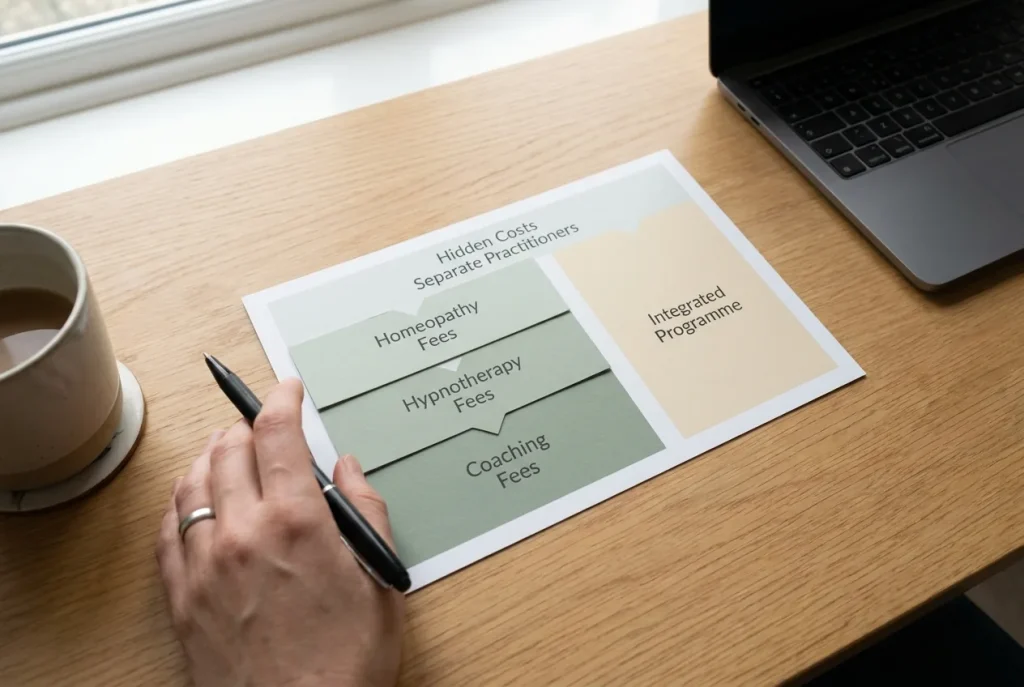
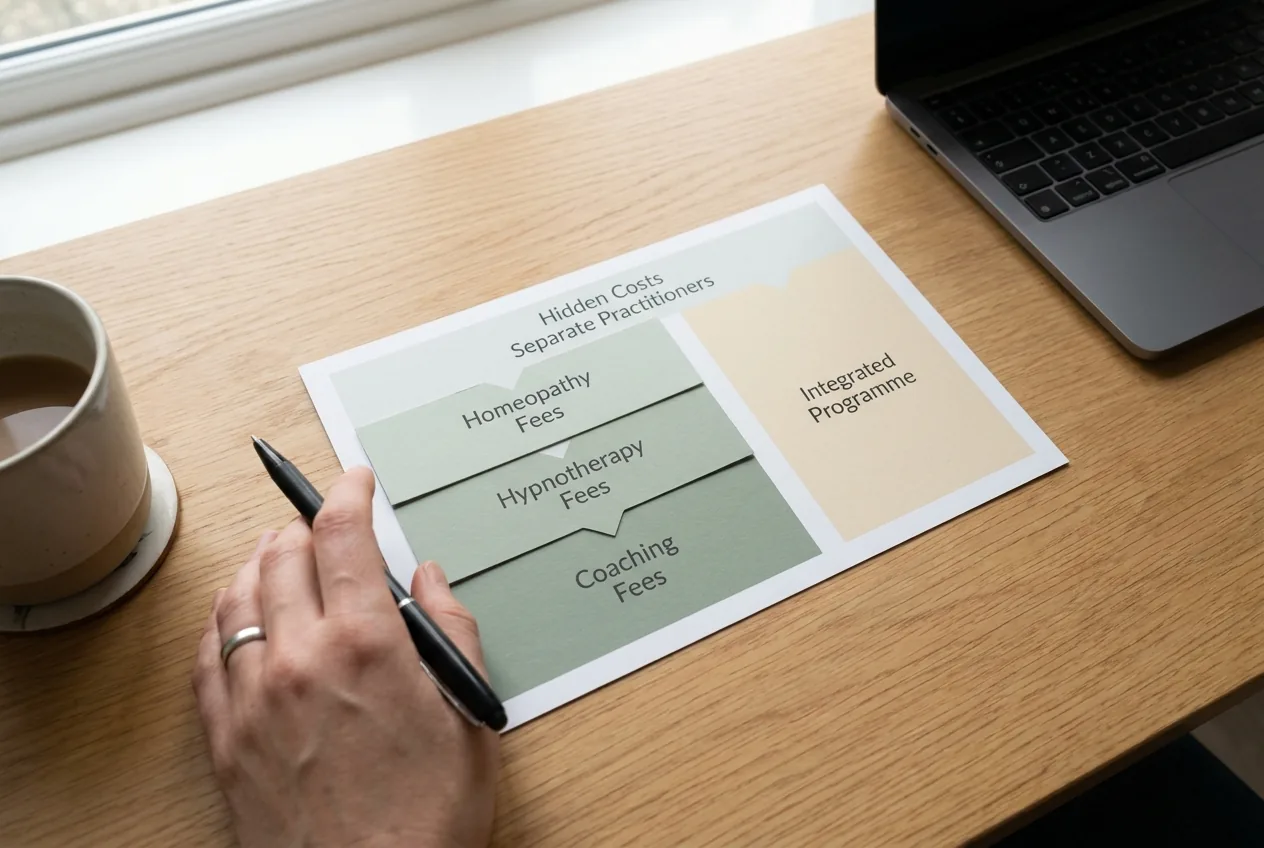
Three hidden costs push the separate-practitioner route 30-50% beyond the fee arithmetic. Duplicate premium-rate intake consultations where you retell your entire history three times. The scheduling burden of managing three separate practitioner diaries alongside everything else. And a communication vacuum where no practitioner sees what the others have found or prescribed.
Here’s where the Post-it calculation breaks down. Three costs that no practitioner’s website will mention, but that every person juggling three separate appointments will actually pay.
1. Three premium-rate intake consultations
Each of your three practitioners will need a first session where you tell them everything. Your full medical history. Your emotional background. What you’ve tried. What’s happening now. These intake sessions typically run 60-120 minutes.Homeopathy Wiltshire charges for 90-120 minute first appointments. London hypnotherapy first appointments include a full interview and assessment lasting up to 90 minutes. And each intake is priced at a premium above the standard follow-up rate.
So you’re paying premium rates, three times, to tell three separate people the same story from scratch. That’s not just a financial cost. By the third retelling, most women are exhausted by their own history.
2. The scheduling burden
You’re on your phone on a Wednesday evening, texting three practitioners about next week. The homeopath has availability on Tuesday morning. The hypnotherapist only does Thursdays. The coach is booked until the following week but has a 7am Monday slot. Each has a different cancellation policy, a different location, and a different diary.
If you’re a senior professional, the time spent coordinating 3-5 weekly appointments across three diaries is not trivial. And if you’re already stretched, which, if you’re reading this, you probably are, that scheduling overhead becomes another thing draining your energy rather than restoring it.
3. The communication vacuum
This is the one that matters most. And the one nobody talks about.
A client came to me who’d previously paid for a scan with another practitioner. She’d walked in hoping for answers and walked out with four or five different supplements and a bill. He hadn’t taken a case. No full history. No timeline. He’d run the scan, looked at what she was sensitive to, and handed her a bag of products.
She took them, because what else do you do? You’ve paid, you’ve sat there, someone in a professional setting has told you “take these.” So you take them. But she told me she’d left that appointment thinking, right, I’ll take these, without understanding why those specific supplements had been chosen, how they connected to what was happening in her body, or what the root cause behind her symptoms actually was.
She had products in hand. She didn’t have understanding.
So when she came to me, we went deeper. We looked at the timeline. We looked at what the scan was actually saying. Not just which sensitivities were flagging, but why her body was reacting to those things in the first place. And instead of handing her another list, I gave her a proper protocol. Not just “take this,” but here’s what’s happening, here’s why, and here’s what you do about it.
That’s the difference between a shopping list and a map. She booked her sister in for the following week.
And this is the thing. On the separate route, your homeopath doesn’t know what your hypnotherapist has uncovered about a childhood pattern driving your physical symptoms. Your coach may set stretch goals your nervous system isn’t yet ready to pursue. Your homeopath is prescribing remedies based on the piece she can see, not the full picture nobody has bothered to assemble.
It shouldn’t be your job to connect the dots between three people you’re paying to help you. But on the separate route, that’s exactly what happens. Because nobody else will.
A 2024 nationally representative UK survey published in BMJ Open explicitly called for strategies to enhance communication between traditional, complementary and integrative medicine providers and conventional healthcare providers, to “ensure patient safety and promote person-centred, coordinated models of care.” That coordination gap isn’t something I’ve made up to sell programmes. It’s a recognised systemic concern, documented in peer-reviewed research on care fragmentation, where care spread across many practitioners with no single provider holding the substantial picture leads to duplicated effort and missed connections.
I’ll be honest with you. The 30-50% cost uplift I cited in the opening is a modelled estimate, not a figure from a published study. No one has directly measured the hidden costs of juggling three complementary practitioners in the UK. But when you add three premium intakes, weekly scheduling friction, and the coordination burden on top of the fee total, the arithmetic gets real. £3,100-£5,500 in session fees realistically becomes £4,000-£7,500 in effective cost.
Some people manage the coordination brilliantly themselves. Most find it harder than they expected.
Separate practitioners vs. an integrated programme
The separate route costs £3,100-£7,500 effective. The integrated route, my Rooted Radiance Immersion, costs £9,999 fixed. The integrated route is more expensive on paper, but includes more sessions, all remedies, between-session access, and one person holding the full clinical picture. Here’s both routes against the same criteria.
The separate-practitioner column uses mid-range published UK rates. The integrated column uses the confirmed pricing and inclusions of my Rooted Radiance Immersion. That’s the programme I can speak to with certainty.
No broader UK market data exists for comparable integrated programmes combining all three modalities, so I can’t tell you whether £9,999 is typical, premium, or mid-market for this kind of offering. That’s an honest limitation of this comparison.
Comparison of the separate-practitioner route versus the Rise Radiantly Rooted Radiance Immersion, using mid-range UK rates for the separate column.
| Criterion | Separate practitioners (mid-range UK rates) | Rise Radiantly Rooted Radiance Immersion |
|---|---|---|
| Total cost (8 weeks) | £3,100-£5,500 fees only; £4,000-£7,500 effective | £9,999 fixed. Payment plans available (2 × £5,250 or 3 × £3,600) |
| Sessions included | 18 (4 homeopathy + 6 hypnotherapy + 8 coaching) | 20 (4 homeopathy + 6 hypnotherapy + 8 coaching + 2 RootScans) |
| Remedies and supplements | Billed separately by each practitioner | Remedies included in programme fee |
| Between-session practitioner access | Appointment-based; each practitioner sets own policy | WhatsApp and Voxer access for 8 weeks |
| Who holds the full clinical picture | No single practitioner; client coordinates | Single practitioner across all modalities |
| Intake consultations | 3 separate intakes (60-120 mins each, premium rate) | 1 comprehensive intake covering all modalities |
| Weekly time commitment | 3-5 appointments across different diaries and locations | 1-2 sessions per week; approx. 3-5 hours including integration practices |
| Financial commitment | Pay-as-you-go; stop or adjust at any time | Single programme fee; limited flexibility to pause |
Two things jump out of that table.
First, the separate route is cheaper on paper, even with hidden costs. The upper end of the effective range (£7,500) still sits below the integrated programme (£9,999). I won’t pretend otherwise.
Second, the integrated route means you’re committed to one practitioner across all modalities. You can’t hand-pick a specialist hypnotherapist with specific trauma credentials and pair them with a different homeopath a friend recommended. For some women, that autonomy matters more than coordination. That’s a genuine trade-off, not a minor detail.
If you want to see exactly what those 20 sessions, included remedies, and between-session support cover, I’ve written a detailed breakdown of what a premium holistic programme includes.
What the table can’t capture is the compounding financial risk of fragmented care. If nobody connects your physical symptoms to your emotional patterns to your subconscious programming, there’s a real chance the entire investment produces temporary relief that doesn’t last. And then you start the cycle again with new practitioners and fresh intake fees.
“I’ve tried everything and nothing has lasted.” That’s the most common sentence I hear from new clients. Almost always, it’s because each practitioner treated their fragment without anyone asking, how does this all connect?
When is seeing separate practitioners genuinely the better choice?
The separate route genuinely wins in two situations. When you only need one modality, making a multi-modality programme unnecessarily expensive. Or when you already have an established practitioner you trust and want to add just one complementary service alongside them. In either case, the honest answer is not “choose the programme.”
When you genuinely need only one modality
If your problem is specific and contained, a phobia of needles, flying, or public speaking, a review of single-session exposure therapy by Öst found that specific phobias can be effectively treated in as few as one to four sessions. You don’t need homeopathy, coaching, and a body scan for a spider phobia. You need a good hypnotherapist, four to six sessions, and you’re done.
Paying £9,999 for a programme containing services you don’t need would be a waste of your money. I’d tell you that to your face.
The same applies to a straightforward acute condition a homeopath can address in a few consultations. Seasonal hay fever. A post-viral cough. An eczema flare-up.
I refer homeopathy-only clients to Hilary Dorrian and nutritional or dietary cases to Malika Guechoul when the full programme isn’t what someone needs. That’s not a marketing line. That’s how I actually practise.
When you already have a practitioner you trust
If you’ve been working with a therapist, coach, or homeopath for months or years and you trust them, they know your history, they understand your patterns, you’ve built real rapport, then replacing that relationship with a new provider you’ve never met isn’t necessarily an upgrade.
Sometimes the right move is to add one complementary modality alongside someone who already knows you. The coordination challenge is real, but an established relationship carries its own clinical value that any new provider has to earn from scratch.
In either situation, the separate route saves you money and serves you better. I’ve written a separate piece on when a less expensive holistic practitioner is genuinely the right choice that covers this in more detail.
When the integrated programme is not the right choice
The Rooted Radiance Immersion is not the right fit if you need only one modality, if you need specialist expertise I don’t hold, if you’re not willing to commit to eight weeks of active participation, or if the upfront cost would cause genuine hardship rather than being a stretch investment.
I want to be specific about this, because vague “it’s not for everyone” disclaimers don’t actually help you decide.
The integrated programme is not the right choice if you need a specialist hypnotherapist with specific PTSD or complex trauma credentials. I trained with Paul McKenna in conversational hypnotherapy, and that serves the vast majority of the clients I work with. But if your situation calls for years of specialist trauma accreditation, a dedicated trauma therapist will serve you better. I’d rather you found the right person than spent £9,999 with the wrong one.
It’s also not the right choice if you’re looking for someone to fix you passively. The programme requires you to show up between sessions. Take the remedies. Do the breathwork. Be honest about what’s really going on. I can’t do the work for you. If you show up but don’t do anything between sessions, you’ll see limited progress regardless of how many modalities are working together.
And honestly, the programme carries a genuine financial limitation. £9,999 is a single lump sum with limited flexibility to pause. If that commitment would cause real financial stress rather than being a considered investment, the pay-as-you-go flexibility of the separate route is a structurally better fit for your situation right now. I’d rather you started with one modality you can afford comfortably than overcommitted and couldn’t sustain the process.
When does an integrated programme make more financial and clinical sense?
Integration makes more sense when your symptoms span body, mind, and subconscious patterns, and especially when you’ve already tried seeing specialists separately without lasting results. The higher price isn’t buying more services. It’s buying one person who can connect the dots that separate practitioners structurally cannot.
I used to be a systems analyst at BT. Spent years tracing where the breakdown happens in complex systems, finding the origin, fixing it properly rather than patching over it. What I see now, 30 years into clinical practice, is that the body works the same way. When one thing is off, it has a knock-on effect on everything else. It’s like a set of clocks on the wall. When one stops, the rest start falling out of time.
A scan without a proper case history only gives you half a map. I learned that lesson watching practitioner after practitioner miss what was right in front of them. One client in particular made it impossible to forget.
She’d been suffering with digestive issues for eighteen years. Not mild discomfort. Proper, life-disrupting digestive problems that had sent her through naturopaths, other homeopaths, and nutritionists. She’d improve for a while with each one, and then it would come back. Every time. Eighteen years of getting better and sliding back, because each practitioner addressed the piece they could see without asking what had started the whole thing.
When she came to me, I did what I always do. I went back. Let’s go back. When did this actually start? And it turned out the digestive symptoms began eighteen years earlier, in Singapore, when she discovered that a family friend had been committing fraud against her parents, charging them double for university fees and pocketing the difference. That betrayal, that shock of discovering someone you trusted had been stealing from your family, was something she found literally indigestible. Her body had been expressing what her mind had tried to move past.
Eighteen years of digestive specialists and not one of them had asked what was happening in her life when the symptoms first appeared. I prescribed shock remedies linked to digestion. The symptoms cleared permanently. She never came back, because she didn’t need to.
No scan on its own would have found that. No supplement protocol would have touched it. The scan tells me what. The case history from birth to now tells me why. That’s the difference. And it’s a big one.
When you sit across from me, I’m not starting from scratch in three separate rooms. I know what the scan found, what your homeopathic case revealed about your emotional history, what the hypnotherapy sessions are uncovering beneath the surface, and what’s coming up in coaching. Every session informs every other session.
That’s what the price difference pays for. Not more services repackaged, but one connected picture where nothing falls through the gaps.
There’s no magic pill in either route. Results require your commitment and your honesty. But when the problem genuinely spans body, mind, and subconscious patterns, having someone who holds the whole picture changes whether the investment lasts.
Five questions to decide which route fits your situation
Five questions to work through honestly. Your answers will point you toward the separate route or the integrated one. Both are valid depending on your specific situation right now.

Work through these honestly. Both “yes” and “no” answers point to a valid route.
1. Do I genuinely need all three modalities, or just one?
If your issue is specific and contained, a phobia, a short-term trigger, an acute physical condition, one modality is enough. But if your symptoms span your body (fatigue, gut issues, headaches), your emotions (anxiety, guilt, overwhelm), and your patterns (self-sabotage, overwork, inability to switch off), that interconnection is a signal. One size doesn’t fit all, but multiple dimensions usually need multiple tools.
2. Have I already tried seeing specialists separately without lasting results?
If the pattern is “I get better for a while, then it comes back,” that’s worth sitting with. It often means the root hasn’t been found because the practitioners treating you each saw only their piece. You can go to the garden of weeds and cut the tops off. It looks great for a while. But until somebody pulls them out from the roots, they keep growing back.
3. Do I have the time and energy to manage three separate practitioner relationships alongside everything else?
Be honest with yourself on this one. If you’re already stretched, adding three sets of appointments, three diaries, three cancellation policies to your week may create more stress than the treatment relieves.
4. Is connecting the dots between physical symptoms, emotional roots, and subconscious patterns important, or is this genuinely a single-dimension problem?
My approach works on three levels at once. Root cause, going back to when the imbalance started, even if that’s decades ago. Symptom management, what’s happening right now. And organ support, putting in the scaffolding to hold your body up while it heals.
If your problem lives on only one of those levels, you don’t need the other two. If it spans all three, treating them in isolation is often why nothing has stuck.
5. Am I willing to invest in a contained programme with a fixed endpoint, or do I need to pay as I go?
The separate route gives you flexibility. You can stop, adjust, or change practitioners with lower financial risk per appointment. The integrated route gives you a contained structure with a fixed total. If cash flow matters more than certainty right now, pay-as-you-go may be the right fit regardless of which approach would theoretically serve you better.
And if you’re weighing this with a partner, the conversation is easier when you can show the full arithmetic of both routes, including what the fee pages don’t mention.
Neither answer is wrong. The question is which one matches where you actually are right now.
Whichever route you choose, the most important step is making a decision and committing to the process. If you need one modality, find a good practitioner in that discipline and get started. If you need all three, choose how you want them delivered and commit. Every month spent paralysed by this decision, or juggling three practitioners whose recommendations don’t connect, is a month where whatever you’re struggling with keeps running the show.
At senior professional income levels, even a small reduction in cognitive sharpness from unresolved burnout costs you more per month than the difference between any of these options.
If burnout and chronic fatigue are driving your search, our burnout and chronic fatigue recovery guide covers the full landscape of root causes and what actually works, so you’re making this decision from a position of understanding rather than exhaustion.
If you’re still researching and not ready to talk to anyone yet, I’ve written a free guide, 7 Signals Your Body Is Sending That You’re Ignoring, that helps you understand what your symptoms might be telling you before you commit to any route.
If you’ve worked through the questions and you want to see the integrated route in detail, the Rooted Radiance Immersion programme page has the full breakdown and a booking link for a free 30-minute health audit. No commitment, no pressure. Just a conversation about what might actually help.
And if you already know you want the integrated route but want to start with a diagnostic entry point rather than the full programme, the RootScan Breakthrough Session is designed for exactly that.
Sameena Khan
Founder, Rise Radiantly
Frequently Asked Questions
Can I start with one modality and add more later?
Yes, and for some people this is the smartest approach. Start with the modality that addresses your most pressing need. If results last, you may not need the others. If you improve but hit a ceiling, that’s a signal the other layers may be needed, and you’ll have more information about what’s going on by then.
What if I already have a practitioner I trust?
Keep them. A trusted relationship has genuine clinical value. Ask whether they’d be open to coordinating with someone providing a complementary modality. Some will, some won’t. If they won’t, you’ll need to manage the coordination yourself, which is possible but adds the scheduling and communication burden this article describes.
What if the integrated programme doesn’t produce lasting results?
No practitioner, integrated or separate, can guarantee specific outcomes. What I guarantee is my full commitment to the process and every tool in my toolbox. Results depend on you doing the work between sessions. Taking the remedies. Doing the breathwork. Being honest about what’s really going on.
There’s no magic pill, but there is a magic process if you’re willing to be part of it. If you’re looking for someone to fix you passively, neither route will serve you well.
Is homeopathy safe alongside my current medication?
Yes. I never take anyone off their medication. That’s a conversation between you and your GP, not something I decide. Homeopathic remedies work on a different principle and don’t interact with pharmaceutical drugs. If you need your antibiotics, take them. If you need your Hormone Replacement Therapy (HRT), take it. I work around the drug layer, not against it.
How do I know whether my problem needs one modality or all three?
You might not know until you’ve started. A useful first question is whether your issue sits in one clear domain, physical or emotional or behavioural, or whether it spans across them.
If your gut plays up every time you’re stressed, and the stress triggers a pattern of overwork you can’t break, and the overwork is driven by a belief you’ve held since childhood, that’s three layers, not one. A single practitioner addressing only one layer will help. But it probably won’t last.
If anything in this article sounded like your situation, booking a free 30-minute health audit is the simplest way to figure out which route fits. No cost, no commitment. Just an honest conversation about what might actually help.