










Considering hypnotherapy but picturing someone swinging a pocket watch? Confused by prices ranging from £60 to over £500 for what sounds like the same thing?
You’re not alone. Most women I speak to carry the same two fears. Losing control. And wasting money on something that turns out to be nonsense.
This guide covers what hypnotherapy actually involves. Not the stage show version. The clinical kind that works with your subconscious patterns while you remain fully aware.
We’ll walk through the real difference between scripted and conversational approaches. What each costs in the UK right now. And, honestly, when mindset coaching or therapy is genuinely enough without going deeper.
Our goal is to help you make the right decision. Even if that means you don’t need hypnotherapy at all.
Key Insights From This Guide:
- Most hypnotherapy fears come from stage shows, not clinical practice. You stay aware and in control throughout
- UK session prices range from £60 to £555+. The gap is driven by approach, not just marketing
- Scripted hypnotherapy follows a pre-written text. Conversational hypnotherapy responds to what surfaces in the room. These are fundamentally different services
- Mindset coaching is genuinely sufficient when the problem is conscious and strategic. Hypnotherapy earns its place when conscious effort keeps failing
- This approach is not suitable for everyone. Severe psychiatric conditions, passive expectations, and a need for formal medical diagnosis are all clear disqualifiers
What We Will Cover in This Guide:
What Hypnotherapy Actually Is and Why It Has Nothing to Do With Stage Shows
Clinical hypnotherapy is a guided conversation, not a performance. You remain fully conscious. Nobody controls your mind. You can open your eyes and walk out at any point.
The stage hypnosis you’ve seen on television uses group compliance and audience pressure. It has nothing to do with what happens in a clinical setting.
In practice, hypnotherapy works by relaxing your conscious mind enough to access the patterns running underneath. Think of your brain as a motherboard. It’s programming your body to eat, sleep, respond to stress, and recover.
When chronic stress corrupts that programming, the signals aren’t clear any more. Your conscious mind says “I’m fine.” Your body says otherwise.
Roughly 95% of your behaviour is driven by subconscious programming. That’s why positive thinking, goal-setting, and willpower often fail to shift deep-rooted patterns. You’re working with the 5%. The subconscious keeps running the old code.
Hypnotherapy accesses the 95%. That’s the difference. And it’s a big one.
A complete stranger came to me recently for a homeopathy appointment. At the end of the session, I offered five minutes of gentle relaxation because her head felt heavy with stress.
When she opened her eyes, she said, “My head feels lighter. That was amazing. Can I book a separate appointment just for this?”
Nobody swung a watch. Nobody lost control. She was simply guided into a state of calm where something shifted.
She booked her sister in the following week.
What Hypnotherapy Costs in the UK and What Drives the Price Gap
UK hypnotherapy sessions range from roughly £60 to £555 per session. That spread is enormous, and the price alone tells you almost nothing about the quality.
At the lower end, newly qualified practitioners and group formats typically charge £60 to £100. Standard experienced practitioners sit between £90 and £250. Specialist practitioners offering longer sessions with integrated approaches charge £300 to £555+.
At Rise Radiantly, my Hypnotherapy Signature Session runs at £555 as a Founders Breakthrough Rate. That includes a 90-minute deep-dive, a pre-session analysis, a post-session integration audio, and a personalised mindset plan.
Three variables create the gap.
The practitioner’s training depth. A weekend certification and a full clinical training with someone like Paul McKenna produce very different skill levels. Script-based training takes days. Conversational mastery takes years.
Session length and what’s included. A 50-minute scripted session is a different product from a 90-minute breakthrough with bespoke integration tools you keep.
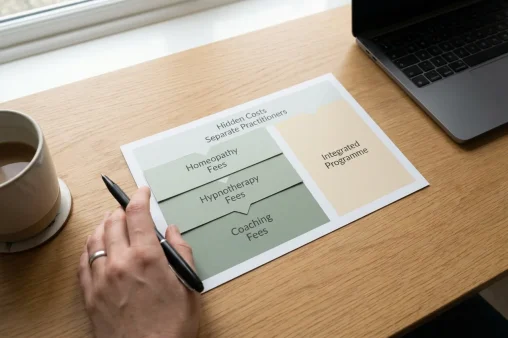
Whether additional modalities are woven in. When hypnotherapy sits alongside homeopathy, scanning, and coaching under one practitioner, the fee reflects that breadth. If you were to see a homeopath, hypnotherapist, and coach separately, the combined cost quickly exceeds an integrated programme, and nobody connects the dots between them.
A detailed guide on hypnotherapy pricing is in development and will appear here when published.
Conversational Hypnotherapy vs Scripted Sessions: Why the Approach Matters
Scripted hypnotherapy follows a pre-written text. The practitioner reads a relaxation script, guides you through a visualisation, and delivers pre-determined suggestions. Every client with anxiety gets the same script.
Conversational hypnotherapy uses no script at all. I trained in the Paul McKenna approach specifically because it works with what surfaces in the room with you. Not what was written on a page last Tuesday for someone else.
If Paul McKenna saw you reading a script, he’d tell you off. That’s the training ethos.
Here’s why this distinction matters for your results.
Anxiety is an umbrella word. What does anxiety mean for you? Where do you feel it in your body? When did it start? What happened in your life at that point?
Your version of anxiety is different from the next woman’s. A script can’t adapt to that. A conversation can.

I had a dentist who booked double sessions with me. After the homeopathic consultation, she’d lie on the couch for energy healing.
During one session, I did a short hypnotherapy relaxation with her. She said, “That was really good. Can you send me that as a voice message so I can use it when I’m there?”
She was going to Turkey for fertility treatment. She wanted to carry the experience with her. So I recorded a personalised relaxation and sent it to her phone.
That recording was tailored to her. A script would have been generic. The difference between those two things is the difference between something you use once and something you reach for when it matters.
A detailed comparison of conversational and scripted hypnotherapy approaches is being developed for this section.
When Mindset Coaching or Talk Therapy Is Genuinely Enough
Hypnotherapy is not always the answer. I mean that.
Mindset coaching works brilliantly when your problem is conscious and strategic. You can’t see clearly through competing priorities. Imposter syndrome is paralysing your decisions. You need accountability and a clearer direction.
Three sessions with a good coach and you’re moving.
Talk therapy is the right path when you need to process grief, clinical anxiety, PTSD, or trauma within a regulated framework. Cognitive behavioural therapy has decades of evidence behind it. EMDR is specifically designed for trauma processing.
If your challenge lives at the thinking level, stay at the thinking level. A £200 coaching session that sorts your clarity is better value than any amount of subconscious work for a problem that doesn’t live in the subconscious.
The honest question is this. Have your conscious efforts been enough?
If you’ve done the coaching, set the goals, built the morning routine, and you’re still waking at 3am with your heart racing, still crashing by 2pm, still carrying patterns you can see clearly but cannot stop repeating, the conscious layer has done its job. It’s the layer underneath that hasn’t shifted.
When Your Body Needs Something at the Subconscious Level
This is where hypnotherapy earns its place.
A human rights solicitor came to me through family referrals. From the outside, she was formidable. Fighting cases in court. Leading teams. Holding everything together.
From the inside, she was crumbling.
She’d been approaching her symptoms mechanically. “I have this issue, I need this drug.” That’s how high achievers operate, right? Manage it. Push through.
When we combined homeopathy with coaching and subconscious work, something shifted that went beyond her symptoms. She gained the clarity and courage to relocate her entire family to another country.
She told me, “It was because of you. You helped me think that I can do this.”
If she’d just seen a coach, she’d still be in pain. If she’d just done the remedies, she might not have found the courage. It was both together.
The subconscious holds the programming that runs beneath your willpower. Your beliefs about rest. Your patterns around overgiving. The identity you built around being the strong one.
No amount of journalling changes code running at that depth. Hypnotherapy accesses it directly.
That doesn’t mean it replaces coaching or therapy. It means it addresses the layer they cannot reach.
Who Hypnotherapy Is Genuinely Not For
I’d rather lose a booking than waste your money. Six situations where hypnotherapy is the wrong choice.
You have a severe psychiatric condition. Active psychosis, acute mania, unstable bipolar disorder. These need psychiatric care, not hypnotherapy. I learned this boundary through direct clinical experience and I hold it without exception.
You want a passive experience. Hypnotherapy requires your participation. If you expect to lie back while someone “fixes” you, the results will disappoint. There’s no magic pill. There is a process, and it needs you in it.
You need a formal medical diagnosis. Hypnotherapy doesn’t diagnose anything. If you need a named condition for your GP, employer, or insurer, see your doctor first.
Your problem is purely situational. A toxic workplace needs a career change, not a trance state. If removing the stressor would solve it, start there.
You’re looking for stage-show entertainment. Clinical hypnotherapy isn’t a party trick. If you’re curious rather than committed, save your money.
You’re not willing to look at emotional roots. The subconscious work only goes as deep as your honesty allows. If you’re going to say “just deal with the anxiety, don’t ask about my life,” you’re in the wrong space.

Frequently Asked Questions About Hypnotherapy
Will I lose control during hypnotherapy?
No. You remain aware throughout. You can open your eyes, speak, and stop the session at any point. I often say to people, “I didn’t hypnotise you. I’m just relaxing you.” Clinical hypnotherapy is closer to guided stress management than anything you’ve seen on television.
How many sessions will I need?
It depends entirely on your situation. One size doesn’t fit all. For a contained issue like pre-performance anxiety, three to six sessions may be enough. For deeply rooted patterns linked to years of chronic stress or unresolved emotional history, hypnotherapy works best as part of a broader integrated approach over eight weeks or more.
Can I have hypnotherapy alongside my current medication?
Yes. I never take anyone off their medication. That’s between you and your GP. Hypnotherapy works alongside whatever you’re currently taking. If you need the antidepressants, take them. We work with your body, not against it.
Is hypnotherapy scientifically proven?
Gut-directed hypnotherapy has moderate-to-strong evidence for conditions like IBS. A 2025 systematic review reported an 81% responder rate in the strongest trial. For anxiety and stress, the evidence base is growing but less robust than for CBT. I won’t overstate the research. What I can tell you is that in 30 years of practice, the shifts I’ve seen when subconscious work is added to the mix are consistently deeper and more lasting.
What if I’ve tried hypnotherapy before and it didn’t work?
Not all hypnotherapists work the same way. A scripted session and a conversational one are fundamentally different services. If your previous experience followed a generic script, the approach may not have matched your individual pattern. The question worth asking is whether anyone adapted the session to you specifically, or whether you received the same thing everyone else did.
Can I do sessions online?
Yes. About half of my sessions happen via Zoom. The same conversational approach works remotely. You need a quiet, comfortable space where you won’t be interrupted, a stable internet connection, and willingness to engage. The depth of the work doesn’t diminish through a screen.
When You’re Ready to Explore Whether This Fits
Before you book anything, sit with one question.
Has conscious effort been enough? If your coaching, your therapy, your willpower, and your morning routine have produced the clarity you wanted but your body still hasn’t caught up, the subconscious layer may be what’s missing.
That isn’t a failure of your previous work. It’s a signal that the roots go deeper than the thinking mind can reach.
If you’re not sure, a free health audit is the simplest way to find out. No pitch. No pressure. Just an honest conversation about whether hypnotherapy, or something else entirely, fits your specific situation.Book a free 30-minute health audit
And if you’re not ready for that conversation yet, this guide will still be here. Come back when the timing is right.
Sameena Khan Founder, Rise Radiantly
All Articles in This Guide
Understanding Your Investment
- What it actually costs to see a homeopath, hypnotherapist, and coach separately: The real arithmetic when three practitioners each address one piece, and nobody connects what your body is telling them.
More detailed guides on hypnotherapy types, session costs, and comparisons between approaches are being developed and will appear here as they publish.