If the results are so life-changing, why does nobody talk about the week you almost quit?
I’ll tell you what a holistic healing programme actually feels like, because most practitioners won’t. The honest answer is this. It’s the hardest, most confronting, most worthwhile thing most of my clients have ever done for themselves. If you’re curious about timelines, our article ‘How Long Does Holistic Healing Actually Take to Show Me Real Results?‘ gives you a realistic picture, and if you’re not sure what to expect from your first appointment, our guide ‘What Actually Happens in My First Holistic Healing Consultation (an Honest Walkthrough)?‘ walks you through it minute by minute.
The eight-week Rooted Radiance Immersion I run at Rise Radiantly combines bioenergetic scanning, homeopathy, hypnotherapy and coaching, and it asks 3 to 5 hours of your week, every week. Some sessions produce breakthroughs that shift your entire understanding of why you’ve been unwell. Others feel like nothing happened at all.
Both are part of the process. And the women who’ve come through the other side consistently say the same thing. The weeks that felt hardest were the weeks that mattered most.
Here’s what most programme pages won’t admit. Not every session produces a visible shift. I’m a solo practitioner, which means the quality of attention you get is exceptional, but it also means my response time between sessions varies when I’m with another client or abroad at my clinic in Gambia.
And if you’ve been on medications for 15 or 20 years, eight weeks won’t undo two decades of drug layers. It will start the process. It won’t finish it.
That’s the truth. And I’d rather you hear it from me now than discover it in week four.
Key Takeaways
- The first consultation typically reframes decades of symptom-chasing in a single session by tracing your timeline back to the emotional origin of your condition
- Weeks 2 to 4 are the hardest part of the programme for most women, with old emotions surfacing unexpectedly, but research confirms this mid-programme difficulty is normal and doesn’t predict a worse outcome
- You’ll be asked to commit 3 to 5 hours per week including sessions, homework (journaling, breathwork, dietary changes) and personalised hypnotherapy recordings
- This programme is genuinely not for everyone. If you want your symptoms treated without exploring your emotional history, or you expect passive healing, I’ll redirect you honestly
- The transformation clients describe months later isn’t just symptom resolution. It’s a fundamentally different relationship with their own body, their decisions and their family
Want to skip ahead to a specific phase?
- Curious about that first appointment where everything gets reframed? Jump to the first consultation.
- Worried about the difficult middle weeks? Read about weeks 2 to 4.
- Need to know what’s expected of you between sessions? See the homework reality.
- Want to know if this is genuinely right for you? Check the fit criteria.
What does the first consultation actually feel like?
Most women who sit across from me have already spent years, and often thousands of pounds, seeing doctors, naturopaths, nutritionists and other homeopaths. In my experience, many have invested £15,000 or more on treatments that managed symptoms without ever finding the root cause.
So by the time they’re in my clinic, they’re exhausted. Not just physically. Emotionally.
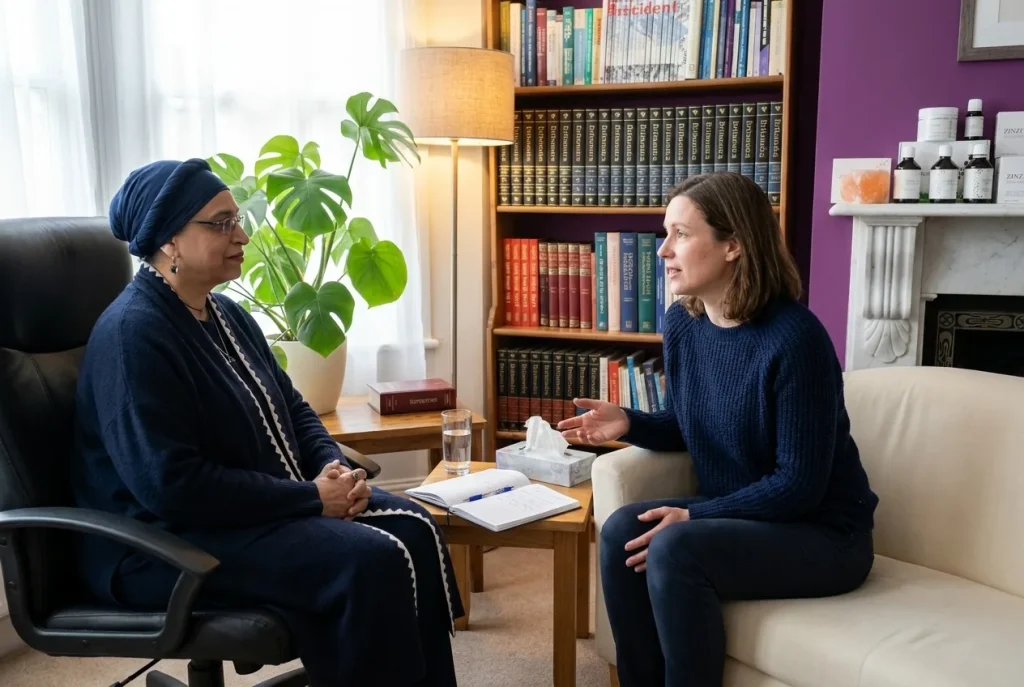
The first thing I do is something most practitioners don’t. I take your full history from birth to now. Not “what medication are you on?” but “when did this start? What was happening in your life at that point?”
That’s where it gets interesting.
Grace Edwards came to me after 18 years of digestive problems. Eighteen years. She’d been everywhere. Doctors, naturopaths, other homeopaths, nutritionists. She’d improve for a bit, then it would come back. Always came back. She’d spent thousands of pounds across those practitioners and still had no answer that lasted.
When she sat down with me, I said, well, if you’ve had this for 18 years, I need to start from 18 years ago. Let’s go back. Let’s go back. Let’s go back.
It turned out that 18 years earlier, while she was living in Singapore, a family friend had committed financial fraud against her parents. Charged them double for university fees and pocketed the difference. The betrayal was devastating.
And when I said to her, “You found that really hard to digest, didn’t you?” her face changed completely.
There you go. That’s your root.
I prescribed shock remedies linked to digestion. Her symptoms cleared permanently. She didn’t need to come back.
Think about what that means. Every practitioner Grace Edwards had seen over those 18 years had asked about her gut. About her diet. About what she was eating and when. Not one of them had asked what happened to her emotionally around the time the symptoms first appeared. Not one of them had traced her timeline back to that moment in Singapore and made the connection between an indigestible emotional shock and a digestive system that couldn’t settle.
Now, I’m not going to pretend a GP would draw the same line I do. This connection between an emotional event and a physical symptom sits in a holistic framework, not a medical one. You won’t find randomised controlled trials proving that financial betrayal causes digestive problems.
What you will find is a woman who spent 18 years and thousands of pounds on approaches that never asked the right question. And one that did.
Not every first session produces a revelation that dramatic. Sometimes it takes two or three appointments.
And I should be honest about something else. I’ve had women come in expecting the scan to work like an MRI (magnetic resonance imaging), to give them a named diagnosis they can take to their insurer or their employer. When I explain that I’m looking at energetic imbalances, not clinical labels, some are disappointed.
That’s a real mismatch in expectations, and when it happens, I’ll redirect them to their GP for the diagnosis and offer to work alongside once they have it. I’ve given extra sessions at no charge when that initial expectation gap meant the first appointment didn’t land the way either of us hoped.
I’ve written separately about what happens minute by minute in that first session, if you want the full detail before committing.
What happens during weeks 2 to 4 (the part nobody warns you about)?
This is the section the wellness industry doesn’t want you to read.
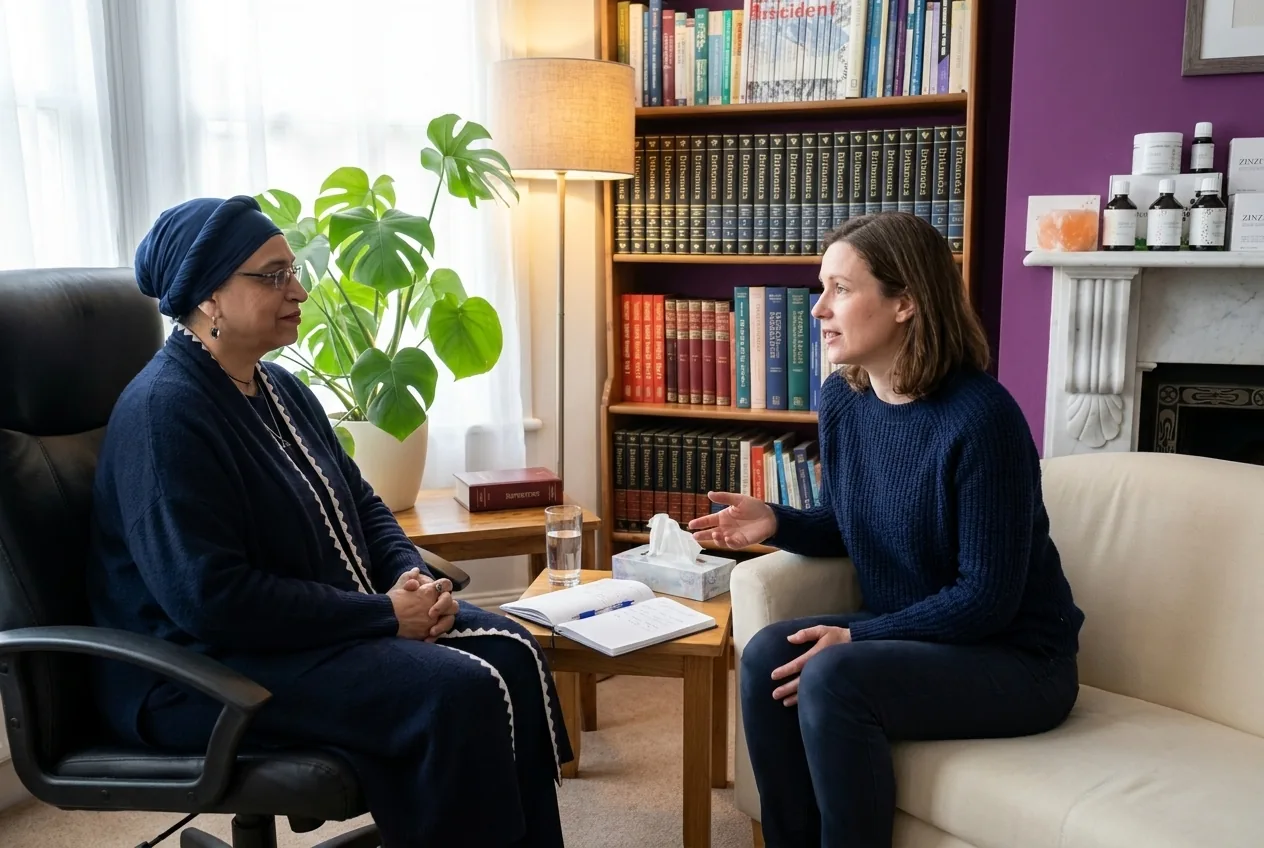
Every programme page shows you the glowing “before and after.” The testimonial that says “it changed my life.” What nobody describes is the Wednesday in week three when you’re crying in the shower because a hypnotherapy session brought up a memory from your childhood that you’d completely buried.
Or the morning your skin breaks out and you’re wondering whether the remedies are making things worse.
I call this “peeling the onion layer.” You’re not getting worse. You’re getting deeper.
This isn’t unique to my approach. A 2024 peer-reviewed study found that roughly 69% of people in intensive therapeutic programmes reported at least one negative experience after just four sessions. Feeling overwhelmed by emotions. Old memories resurfacing. Increased tension.
The critical bit is this. Those negative experiences did not predict a worse outcome. The discomfort was part of the process, not a sign of failure.
In my own practice, fewer than 1 in 10 clients experience what I’d call a genuine healing crisis, a physical flare-up like a skin eruption or vivid dreams. That figure comes from my own clinical observation over three decades, not a peer-reviewed study, and I want to be upfront about that. Other practitioners report aggravation rates anywhere from near zero to 25%, depending on who’s measuring and how.
What I’m actually doing during those weeks
I call it the three-legged stool. Three things simultaneously. The root cause, going back to when the imbalance started. Symptom management, alleviating what’s happening right now. And organ support, putting the scaffolding in to hold your body up while we do the deeper work.
One thing I won’t sugarcoat. If you’ve been living with a chronic autoimmune condition, or you’ve been on medications for 15 to 20 years, even with full compliance, the speed and degree of change within eight weeks may be moderate rather than dramatic.
Every fully engaged client I’ve worked with has experienced some shift. But I’d be dishonest if I told you the timeline is the same for everyone. Some conditions need longer. That’s biology, not failure.
If you want to understand how long results typically take, our article ‘How Long Does Holistic Healing Actually Take to Show Me Real Results?‘ breaks that down separately.
How do you tell the difference between productive discomfort and something genuinely going wrong? That’s where the between-session support comes in.
What are you expected to do between sessions?
This is where my approach differs from most holistic practitioners.
You won’t just see me once a week and go home. Between sessions, you have homework. Real homework.
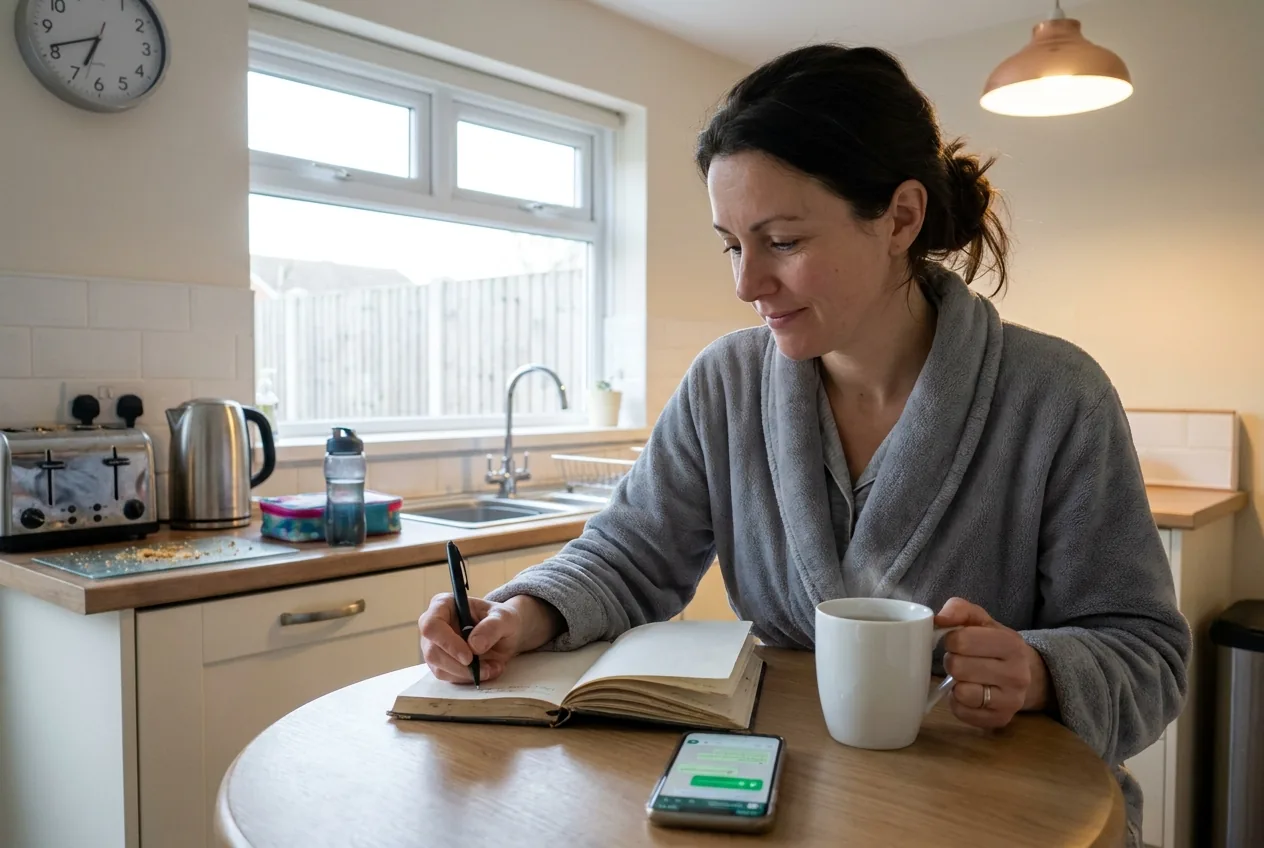
Gratitude journaling. Breathwork, ideally every couple of hours. The DHEA (dehydroepiandrosterone) exercise, where I ask you to create a mental shoebox of your happiest memories, the kind where you get a warmth in the pit of your stomach and your lips go up. That warmth is what releases the hormone DHEA.
Dietary adjustments tailored to what the scan revealed. And personalised hypnotherapy recordings you listen to at home.
I know what you’re thinking. “I’m running a business. I’ve got children. When exactly am I supposed to do breathwork every two hours?”
Fair question. Research into between-session homework shows the biggest barrier isn’t motivation. It’s feeling overwhelmed by the volume of tasks.
That’s why I tailor the homework to your week, not mine. If 6am journaling before the school run works but a lunchtime breathwork pause doesn’t, we adjust. The programme asks for 3 to 5 hours per week in total, including your sessions. That’s non-negotiable if you want real results.
Why between-session contact changes everything
The other thing that makes this different is direct WhatsApp voice-note access to me throughout the programme. If something comes up on a Tuesday night, an emotional flashback, a symptom flare, a question about your remedies, you send me a voice note.
“If I don’t pick up, it’s because I’m with somebody else, but you leave a voice message and I’ll get back to you within 24 hours.”
This matters more than you’d think. The strongest predictor of whether someone pushes through the difficult middle weeks or drops out is the quality of the relationship between client and practitioner. That’s not my opinion. That’s what the psychotherapy dropout literature consistently shows.
The between-session contact isn’t a luxury add-on. It’s the thing that holds the programme together when week three feels impossible.
Who should not do this programme (and who is it perfect for)?
I’d rather lose you as a client now than disappoint you in week five. These disqualification criteria aren’t unique to me. They apply to any intensive holistic programme worth its fee.
So here’s who this genuinely isn’t for.
1. The person who says, “Just deal with my digestion. I don’t want to discuss my emotions.”
I hear this more often than you’d think. And I understand it. But if you come to me wanting your physical symptoms treated in isolation, without exploring your emotional history, you’re in the wrong space.
The mind-body connection is the foundation of everything I do. If you’re not open to that, I can’t help you in the way this programme is designed to help.
2. The persopn who expects passive healing.
There’s no magic pill, but there is a magic process. Are you going to be part of that process? We work together as a team. You’re not going to come to me to just fix you. I’m not going to do that.
If you don’t take your remedies, don’t do the journaling, don’t engage with the homework, and then tell me at week six that nothing’s shifted, that’s not a programme failure. That’s a partnership that didn’t happen.
3. The person who primarily needs a formal medical diagnosis.
If you need a named diagnosis for insurance, legal or employer purposes, I can’t provide that. If anyone’s expecting a diagnosis, you’re in the wrong place. I work with energetic imbalances and emotional root causes, not clinical labels.
You need a GP or specialist first. I’ll happily work alongside them afterwards.
Who this IS a perfect fit for
The person who’s already tried the conventional route, and the alternative route, and is still unwell. Who knows something’s wrong even though every test comes back “normal.”
Who’s willing to be honest about her past, take her remedies, do the homework and commit to those 3 to 5 hours a week for eight weeks. Who wants to understand why her body is doing what it’s doing, not just make it stop.
I’ve written separately about the real limitations of root cause healing, including the conditions where progress is genuinely slower and what I can’t help with. Worth reading alongside this if you’re weighing up whether to commit.
Five questions to ask any holistic practitioner before you commit (including me)
- Will you take my full history from birth to now, or just assess my current symptoms?
- What happens between sessions, and how do I contact you if something comes up?
- Do you work alongside my GP and current medication, or do I have to choose?
- What does the difficult middle phase look like, and how do you support me through it?
- What happens when someone doesn’t get the results they expected?
If the answers are vague, that tells you everything you need to know.
What does life look like three to six months after the programme ends?
This is the part I care about most. Not what happens in week eight. What happens in month six.
The human rights solicitor who came to me was the kind of woman you’d never guess was struggling. Outwardly strong, accomplished, respected in her field. But from the inside, she was crumbling. Hormonal imbalances, emotional exhaustion, the kind of fatigue that a holiday can’t fix.
She’d been carrying everything. The court cases, the family, the pressure. And her body had been keeping score.
She was also the kind of woman who didn’t want to own up to being unwell, because admitting it felt like it would bring down the strong person everyone relied on. When she first came through the door, referred by family, it took time before she’d talk about the weaknesses underneath the professional exterior.
After working through the programme and coaching together, something shifted that went far beyond her physical symptoms. She gained the clarity and courage to relocate her entire family to another country. Not because I told her to. Because addressing the root of what was weighing her down physically freed something psychologically that had been locked for years. She told me it was the coaching that gave her the courage to take that step.
But here’s the part that really stays with me. What I taught her, she brought into her family. She taught her kid and her husband the same tools. And that created a better outcome for everyone.
Her family members independently noticed the change in her. Not because she told them about the programme. Because they could see it. Her husband responded differently. Her child picked up the practices. The healing didn’t stay in my clinic. It went home with her and changed the way her whole household operated.
Three types of lasting change
The transformation clients describe three to six months later usually falls into three categories. Physical resolution, yes. But also psychological shifts, new courage, new boundaries, decisions they’d been putting off for years.
And what I call the family ripple, where the people closest to you start to notice without being told.Research on intensive programmes supports this. A study tracking participants after an intensive treatment programme found that gains didn’t just hold at six months. They actually increased. The strongest predictor of whether improvements lasted was whether the person continued practising the skills they’d learned.
That’s exactly why I build lifelong tools into the programme. The breathwork, the journaling, the body-awareness practices. They aren’t just homework for eight weeks. They’re habits you take with you. So the old patterns don’t come back.
I won’t pretend I have formal six-month outcome data for this specific programme. I don’t. What I have is clinical observation across three decades and the consistent feedback from women who tell me, months or years later, that the tools stuck and the shifts held.
That’s not a controlled trial. It’s also not nothing.
The truth that builds trust
Here’s what I want you to sit with.
The difficulty is the mechanism. Not a flaw.
The session where you cried was the session where something moved. The week where nothing seemed to happen was the week your body was processing beneath the surface. The homework you nearly didn’t do was building the habits that keep you well after the programme ends.
Every month you push through without addressing the root cause, the patterns deepen. The medication layers compound. And the woman you used to be recedes further behind the performance you’re maintaining for everyone else.
I know, because I walked that road myself. I ignored my own body’s signals until it forced me to stop.
If you’ve read this far and you recognise yourself in these pages, the next step isn’t more reading. It’s a conversation.
I offer a free 30-minute health audit where I can honestly tell you whether this programme fits your specific situation. No obligation, no pressure, just a straight conversation about what might help.
If you already know you want to see the full programme, you can explore the Rooted Radiance Immersion here.
And if you’re not ready for a conversation yet, I’ve explored this in our article ‘Is Holistic Root Cause Healing Actually Worth the Investment?‘, and have also written about the honest limitations of this approach. If you want to understand the full landscape of recovery options first, the burnout and fatigue recovery guide covers everything from conventional treatment to root cause healing. Read those first. There’s no rush.
I only take four clients per quarter for this programme, and the next opening could be three to six months away. If this is landing for you, the sooner we have the conversation, the sooner we figure out if it’s right.
Sameena Khan
Founder, Rise Radiantly
Frequently Asked Questions
Will I get worse before I get better?
Temporary emotional discomfort is common and normal. Physical healing crises are rare. I covered the detail and the research in the weeks 2 to 4 section above, including what I do to support you through it.
What if I can’t commit to the full 3 to 5 hours per week?
Then honestly, this programme isn’t the right fit right now. If your schedule can’t accommodate it, a standalone RootScan Breakthrough Session at £2,222 is a complete experience in itself and doesn’t require the same weekly commitment.
Do I have to stop my medication?
No. I’ll never take you off your medication. I work around the drug layer, alongside your GP, not instead of them.
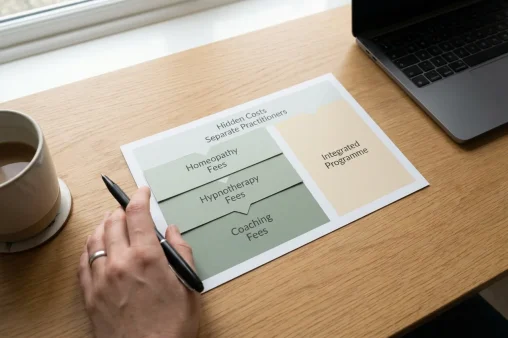
How is this different from seeing a homeopath, a hypnotherapist and a coach separately?
Because they’d each be working in their own lane without seeing the full picture. Your homeopath doesn’t know what surfaced in your hypnotherapy session. Your coach doesn’t know what your scan revealed about your liver.
Here, I hold the whole picture, because I’m the one person across all of it. That’s the difference. And it’s a big one.
What if it doesn’t work for me?
No one can guarantee 100% anything. I won’t pretend otherwise. In my experience, every woman who did the work experienced a shift.
For women with long-standing autoimmune conditions or years of medication layers, that shift may be moderate within eight weeks rather than complete, and continued work beyond the programme may be needed. The honest answer is that the limitation is usually speed and degree, not whether change happens at all.
Still have questions? Book a free 30-minute health audit and let’s talk through your specific situation.