
The practitioner with the most polished website, the biggest Instagram following, and the Harley Street address is almost certainly not the one who’ll actually resolve your burnout. And the criteria that do predict results? You won’t find them on any standard “best of” list.
For most professionals dealing with burnout in the UK, the strongest choice depends on what’s driving the problem. If you want hard lab data combined with trauma-informed body work, Anna Marsh offers the most transparently priced functional medicine option (from £39 per month to £3,750 plus VAT). If you need immersive residential care, Fiona Arrigo’s Arrigo Programme is the only practitioner on this list whose credentials I could independently verify on a public professional register, though retreats start from £14,000. For a nutrition-focused entry point under £1,000, Jade Leighton’s Holistic Health Method is partially verified on the British Association for Nutrition and Lifestyle Medicine (BANT) register and starts from £875.
If you’re not sure which type of support is right for you, our article ‘Mindset Coach Vs Therapist Vs Holistic Practitioner – Which Do I Actually Need?‘ is worth reading first.
Full disclosure. This article is published on the Rise Radiantly website. I’m Sameena Khan, and I’m one of the practitioners on this list. I hold a BSc in Homeopathy and 30 years of clinical experience. I’ve applied the same five evaluation criteria to myself as to everyone else, including the uncomfortable parts. If your budget is under £1,000, or your burnout is purely operational rather than rooted in physical symptoms or unresolved emotional patterns, another practitioner here will serve you better than I will.
You can verify every claim independently. The trust doesn’t come from my absence. It comes from my honesty about being here.
Before you go any further, something worth knowing. Most “best holistic practitioner” lists you’ll find online are either affiliate-driven (the author earns commission from every booking), self-promotional (the author conveniently ranks themselves first), or directory-style listings with no evaluation criteria at all. If the list you’re reading doesn’t explain exactly how “best” was determined, doesn’t name specific strengths and weaknesses for every option including the author’s own practice, and doesn’t tell you who it’s NOT suitable for, it exists to sell. Not to help you choose.
Check the next three lists you find. Look for a disclosure statement and honest limitations. You’ll see what I mean.
Key Takeaways
- Only two practitioners on this list have independently verifiable credentials. Fiona Arrigo (verified on the Institute of Biodynamic Medicine register) and Jade Leighton (partially, BANT). Ask for registration numbers before you book anyone.
- Three of the seven publish pricing. The rest need a discovery call. Hidden pricing is a data point, not a detail.
- No practitioner here, including me, has independent third-party reviews for 2024–2026. Every one relies on self-hosted testimonials. That tells you something about this entire market.
- Qualification breadth matters more than any single credential. A practitioner trained across multiple disciplines sees connections a single-modality specialist simply can’t.
- Burnout in professional women is at record levels.964,000 UK workers reported stress-related illness in 2024/25, with women aged 35–54 significantly more affected than the workforce average. This list exists because of a real need.
Here for one specific thing?
- Want to know what separates a good practitioner from a polished website? See the five evaluation criteria.
- Ready to compare everyone side by side? Jump to the comparison table.
- Need to know who each option is best for? Read the practitioner profiles.
- Not sure holistic is even the right path? Check the disqualification guidance.
What actually makes a holistic burnout practitioner good enough to trust with your recovery?
Five criteria separate practitioners who get to the root of your burnout from the ones who’ll spend months managing symptoms while the real problem stays buried. You shouldn’t have to become an expert in evaluating practitioners just to get help. But right now, that’s exactly what the market demands.
1. Do they hold qualifications across multiple disciplines, or just one?
Burnout isn’t a single-system problem. It hits your hormones, your nervous system, your gut, your sleep, your emotional patterns. A practitioner trained in only one modality sees your situation through that one lens. And that lens, no matter how good, will miss things.
I’ve spent roughly 30 years building qualifications across multiple disciplines, not because I collect certificates, but because every time I deepened one area, I could see how much I was missing from another. Homeopathy, bioenergetic scanning, hypnotherapy, coaching, counselling, nutrition, energy healing. Each one opened a door that the others couldn’t.
I saw how much this matters when I trained on the Qest4 bioenergetic scanning system in Utah. I was the only homeopath in the room. Everyone else was a nutritionist, a kinesiologist, a psychiatrist. Same machine. Same scan data. Completely different interpretations, because each person could only read through the lens of their own training.
That’s when it became clear. The scan is only as useful as the breadth of what the practitioner brings to it. A nutritionist reads it one way. A psychiatrist reads it another. I read it through 30 years of working with bodies, minds, emotions, and energy systems together. That’s the difference. And it’s a big one.
Ask any practitioner before you book: “What qualifications do you hold, and how do they work together to create an integrated plan rather than a single-modality one?”
2. Do they investigate root causes, or apply standardised protocols?
There’s a world of difference between a practitioner who asks “what’s wrong?” and one who asks “when did this start, and what was happening in your life at that point?”
The first manages symptoms. The second investigates why those symptoms showed up in the first place.
You can go to the garden of weeds. You can cut them at the top and it looks clean. But until you pull them out from the roots, they keep growing. Your body’s the same.
People don’t realise, for instance, that a chronic cough can be a very emotional cough. Something happened. The body remembers it, even when you’ve moved on. Unless someone asks when that cough started and what was going on at the time, you’ll keep treating the cough and never touch the root.
Ask any practitioner before you book: “How do you differentiate between managing my symptoms and resolving what’s actually driving them?”
3. Have they worked with professional women specifically?
Women aged 35–44 and 45–54 have work-related stress rates significantly higher than the workforce average, according to the Health and Safety Executive. The pressures facing a senior leader or founder are specific. From the face front, they’re quite strong women. But from inside, they’re crumbling.
A practitioner who doesn’t understand the “double burden,” the performance expectations, or the inability to show weakness won’t ask the right questions. And the wrong questions lead to surface-level answers.
If you’re wondering about this, our article ‘Can I Actually Recover From Burnout Without Quitting My Job or Stepping Back?‘ is worth reading before your first call with anyone.
Ask any practitioner before you book: “Can you share specific examples of how you’ve helped women in senior roles recover while maintaining a demanding career?”

4. Will they work alongside your GP and medication?
This one could save you from a genuinely dangerous situation. I’ve heard it too many times.
“My last homeopath told me I couldn’t use homeopathy while on medication.”
That’s incorrect. I disagree with any practitioner who says that. If you need to take the antibiotics, take them. If you need the steroids, take them. I’ll help you detox afterwards. A safe practitioner works alongside your existing medical care. Not against it.
What alarmed me when researching this list is that explicit GP collaboration policies were almost universally absent from practitioner websites. You could commit thousands before discovering your practitioner expects you to choose one path or the other.
Ask any practitioner before you book: “What’s your formal policy on working with clients on prescribed medication, and how do you collaborate with their GP?”
5. How deep is their initial assessment?
A surface-level intake form doesn’t get to the root. I take a full case history from birth to now, because what happened to you at age seven might be driving what’s happening in your gut at forty-five. Let’s go back. Let’s go back. That’s how I work.
The specific method matters less than the depth. Some practitioners use functional lab tests. Some use extended case-taking. Some use bioenergetic scans. What matters is whether they’re building a bespoke picture of you before recommending anything, or handing you a standard plan five minutes after you sit down.
Ask any practitioner before you book: “What does your initial assessment involve, and what tools do you use to build a personalised picture before recommending a treatment plan?”
What are the three most expensive mistakes women make when choosing?
These three errors cost thousands of pounds and months of recovery time. Every one is avoidable.
Choosing based on a Harley Street address or Instagram following
No UK evidence suggests that a prestige location or luxury setting correlates with better outcomes for burnout. The Royal College of Psychiatrists and NHS guidance consistently identify practitioner competence and the quality of the therapeutic relationship as the actual determinants. Not the postcode. Not the photography.
I experienced this from the other side. In January this year, I was invited to speak at the Lioness Lounge in Amsterdam. High-achieving women, international founders, CEOs. I didn’t know what kind of event it was. I turned up in jeans and a jumper. Everyone else was in dinner gowns.
The speaker before me was tall, corporate, MBA, seven-figure business coach. Very polished. I thought, right, I’m going to have to match that.
I spoke for ten minutes. No script. No prepared remarks. I told my story. The burnout, the stroke, the restaurant, and how I came back through it. My message was simple. Come home to yourself. Stop trying to please everyone and lead a company at the same time.
Afterwards, women were writing notes from my slides. Several told me it was the best speech of the evening. Not the polished one. Mine. The one delivered in jeans by someone who’d actually been through it.
That moment crystallised something I already knew. Authentic lived experience creates a quality of trust that no certification alone can replicate. When you’re choosing a practitioner, look for someone who’s been where you are. Not just someone who’s studied where you are.
The correction is straightforward. Use the five criteria above. Demand registration numbers. Check them on the Complementary and Natural Healthcare Council register or the relevant professional body.
Not clarifying the GP and medication policy before committing financially
Across every practitioner I researched for this list, explicit GP collaboration policies were the exception, not the rule. You could commit several thousand pounds before discovering your practitioner expects you to choose between their approach and your existing medication.
I’ve seen it cause real problems. Some homeopaths tell clients they can’t use homeopathy if they’re on medication. I disagree with that position. It’s incorrect. But you won’t always know where a practitioner stands until you’ve already paid.
Ask the question from criterion four, before any financial commitment. A safe practitioner will give you a clear answer without hesitation. If they hedge, that’s telling you something.
Comparing the cost of a single session rather than the total cost of recovery
A £40 therapy session that manages symptoms for a week is more expensive in the long run than a programme that gets to the root cause. I see women in my practice who’ve spent £15,000 to £30,000 across multiple practitioners before finding root-cause work. Each one addressed a piece. Nobody connected the dots.
Ask practitioners about average client journey duration and compare total programme cost, not the price of a single appointment. That’s the honest comparison.
How do these practitioners actually compare side by side?
Seven practitioners evaluated against the same five criteria, using publicly available information from their websites, professional body registers, and press coverage. Where data wasn’t available, I’ve said so. Every cell below is a verifiable fact, not my opinion.
Comparison of seven UK holistic burnout recovery practitioners by qualifications, modalities, pricing, diagnostic method, root-cause focus, and GP collaboration policy in 2026
| Practitioner | Qualification types | Modalities | Pricing model | Diagnostic method | Root cause focus (stated) | GP/medication policy |
|---|---|---|---|---|---|---|
| Anna Marsh | MSc Nutrition, IFM cert, SE training, NLP, PNI diploma (not confirmed on public registers) | 4+ (Functional Medicine, Somatic Experiencing, Nutrition, Nervous System retraining) | Transparent, £39+VAT/mo to £3,750+VAT | Functional lab testing, HRV monitoring, somatic assessment | Yes | Yes, works alongside GP, reviews medications, does not alter prescriptions |
| Fiona Arrigo / The Arrigo Programme | IOBM Fellow (verified on IOBM public register); team includes psychiatrists and psychologists | 10+ team-delivered (Psychiatry, Psychology, Biodynamic, Acupuncture, IFS, Breathwork, Somatic Bodywork) | Application-only, from £14,000 for 5 nights | Bespoke pre-retreat consultations | Yes | Not publicly stated |
| Jade Leighton / The Holistic Health Method | DipION, mBANT (partially verified on BANT Cornwall search), rCNHC (not independently confirmed) | 5+ (Nutritional Therapy, Lifestyle Medicine, Functional Testing, Personal Training, Sound Healing) | Partially published, from £725 MOT, from £875 for 3 months | Functional test analysis (incl. SIBO), nutritional assessment | Yes | GP letter provision included; no medication policy stated |
| Lauren Vaknine | Life coaching, NLP, CBT, nutrition (self-study stated; no ICF/EMCC registration found) | 4 (Nutrition, Life Coaching, NLP, CBT) via RISE Membership | RISE Membership £75–£145/mo; 1-to-1 pricing not published | Coaching intake | Not explicitly stated | Not publicly stated |
| Simone Thomas Wellness | Not independently verified on CNHC, BANT, or any professional register | Bioresonance, Nutrition, Supplementation, Gut Health | Not published, discovery call required | Bioresonance device (see notes) | Not explicitly stated | Not publicly stated |
| Lisa Strbac | LCHE BSc(Hons) stated; not found on SoH, ARH, or NCH registers | Homeopathy, Human Design, Quantum Frequencies | Education products $145–$299/yr; 1-to-1 pricing not published | Not stated (education and community model) | Not explicitly stated | Not publicly stated |
| Rise Radiantly (Sameena Aziz Khan) | BSc Homeopathy (Middlesex University), Paul McKenna hypnotherapy cert, Licentiate to Practise (self-reported; not found on CNHC or other public registers) | Multi-modality incl. homeopathy, bioenergetic scanning (Qest4), hypnotherapy, coaching, energy healing | Published, £2,222 RootScan; £9,999 8-week programme | Bioenergetic scan (Qest4) + comprehensive case-taking from birth to present | Yes | Works alongside GP; never requires stopping medication |
Abbreviations used in this table. ARH, Alliance of Registered Homeopaths. BANT, British Association for Nutrition and Lifestyle Medicine. CBT, cognitive behavioural therapy. DipION, Diploma from the Institute for Optimum Nutrition. EMCC, European Mentoring and Coaching Council. HRV, heart rate variability. ICF, International Coach Federation. IFM, Institute for Functional Medicine. IFS, Internal Family Systems. IOBM, Institute of Biodynamic Medicine. mBANT, member of BANT. NCH, National Council for Hypnotherapy. NLP, neuro-linguistic programming. PNI, psychoneuroimmunology. rCNHC, registered with the Complementary and Natural Healthcare Council. SE, Somatic Experiencing. SIBO, small intestinal bacterial overgrowth. SoH, Society of Homeopaths.
The most striking pattern here? How many cells say “Not publicly stated.”
That absence tells you as much as the data itself. A practitioner who doesn’t publish their GP policy, their pricing, or verifiable credentials is making a choice. And that choice is a data point worth weighing before you hand over your card details.
For bioresonance specifically, the Advertising Standards Authority’s published guidance on bioresonance therapy states it has “yet to see any evidence” that bioresonance devices can diagnose or treat medical conditions. The ASA’s broader guidance on complementary therapies applies to any practitioner making health claims, including those using bioenergetic or bioresonance-based assessments.
I checked the Complementary and Natural Healthcare Council (CNHC), the British Association for Counselling and Psychotherapy (BACP), BANT, the Health and Care Professions Council (HCPC), IFM, and relevant specialist registers for every practitioner on this list. Including myself.
Who made the list, and who is each one best suited for?
Each practitioner below, including me, is evaluated against the same five criteria. Same structure. Same honesty.
Anna Marsh
I work with bioenergetic scanning and homeopathy as my primary tools. Anna Marsh comes at burnout from a different starting point, using functional medicine and trauma-informed somatic coaching specifically targeting high-achieving women with fatigue. Her GP collaboration policy is published and unambiguous. She reviews current medications and explicitly encourages clients to continue working with their GP.
Transparent pricing from £39+VAT monthly to £3,750+VAT for a six-month package. Functional lab testing and supplements can add £1,000+ beyond programme fees. Her qualifications couldn’t be independently confirmed on public registers.
Where you trust biochemistry and hard lab data, her approach has the edge over mine. She leads with functional labs and somatic coaching. I lead with bioenergetic scanning and homeopathy. We’re working similar ground from different starting points.
Best for the analytical executive who needs lab data to feel safe but acknowledges she also needs trauma work. Not for you if your burnout doesn’t have physiological roots you want measured, or if somatic body work feels too unfamiliar.
Fiona Arrigo / The Arrigo Programme
My practice works with people week by week, woven into their daily lives. Fiona Arrigo offers something entirely different. Biodynamic psychotherapy through luxury residential retreats in Somerset. The only practitioner on this list with independently verified credentials on a public professional register. Her multi-disciplinary clinical team spans psychiatry, psychology, somatic bodywork, and functional medicine.
Featured in The Times and CN Traveller across a 35-year career. From £14,000 for five nights.
For the right woman at the right moment, that level of removal from daily life can be what creates the breakthrough. It’s also the most expensive option here by a significant margin. And a five-night retreat, however powerful, doesn’t give you the sustained weekly support that deep-rooted burnout usually requires.
Best for the person in acute crisis who needs immediate removal from their environment and can invest at the luxury end. Not for you if you need ongoing weekly support integrated into your working life, or your budget is under £10,000.
Jade Leighton / The Holistic Health Method
Where my approach combines scanning, homeopathy, hypnotherapy, and coaching into one integrated programme, Jade Leighton focuses specifically on the nutritional and lifestyle side. BANT-registered, offering structured programmes from £875 for three months. Includes GP letter provision. Practical approach through nutritional therapy, functional testing, and lifestyle medicine coaching.
If your burnout shows up primarily in your gut, your energy, and your focus, and you suspect food and lifestyle are part of the picture, she’s where I’d look first at this price point. The most accessible premium option on this list.
Best for the professional woman whose burnout manifests as physical symptoms she suspects are diet and lifestyle related. Not for you if your burnout has deep emotional roots alongside the physical symptoms, or you need psychological depth. No hypnotherapy, no trauma work offered.
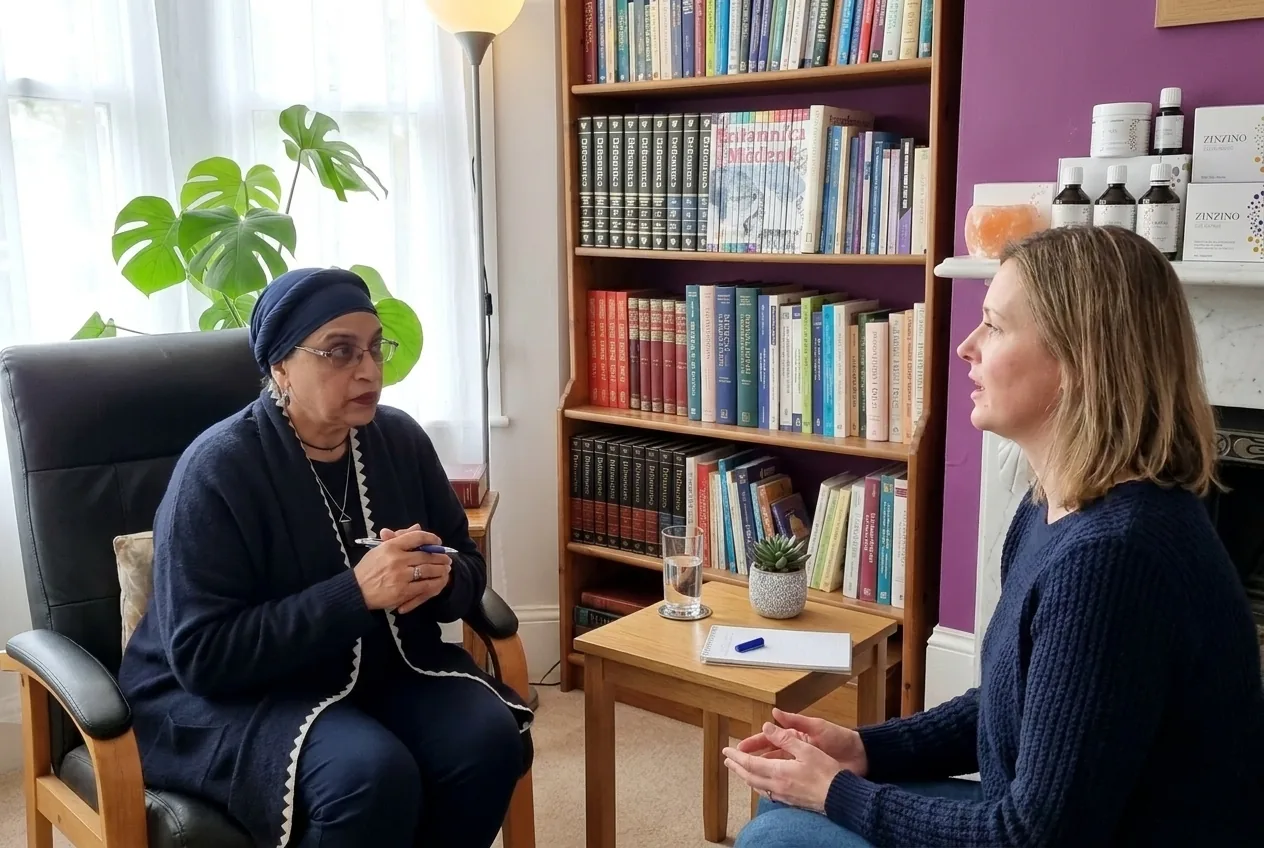
Lauren Vaknine
Lauren Vaknine offers holistic health coaching through the RISE Membership (£75 – £145 per month). Combines nutrition, life coaching, NLP, and cognitive behavioural therapy (CBT) in a community-based self-guided format.
She has a compelling personal healing story. She healed herself from a serious autoimmune condition through the modalities she now teaches. No independent qualification verification found. One-to-one pricing not published.
The community model suits self-motivated women who want ongoing support at a lower price point rather than intensive clinical work.
Best for the self-motivated person who prefers community-based support at an accessible monthly price. Not for you if you need intensive one-to-one clinical work, objective diagnostic data, or a practitioner who explicitly works alongside conventional medication.
Simone Thomas Wellness
Bioresonance screening plus nutritional therapy from Harley Street and Bournemouth. Press coverage in Hello! Magazine. No clinical qualifications independently verified on any professional register. Pricing not published.
I’d encourage any woman considering this option to read the ASA’s published position on bioresonance devices before committing. The Harley Street address is a prestige signal, but as I said in the mistakes section, there’s no evidence that setting correlates with clinical outcomes.
Best for the person open to device-based approaches alongside nutritional therapy, particularly around perimenopause and gut health. Not for you if you need independently verifiable credentials, published pricing, or modalities with a stronger regulatory evidence base.
Lisa Strbac
Homeopathy blended with Human Design and quantum frequencies. Primarily an education and community model. Courses from $145, community from $30 per month. Not found on Society of Homeopaths, Alliance of Registered Homeopaths, or National Council for Hypnotherapy registers.
This is a very different offering from the clinical practitioner model. If you’re drawn to the energetic and spiritual side and want to learn acute homeopathy for self-prescribing, she’s built a strong community around that.
Best for the woman drawn to a spiritual or energetic approach who wants to learn self-prescribing. Not for you if you need intensive, bespoke clinical support for burnout rather than an educational community.
Rise Radiantly (Sameena Aziz Khan)
This is my practice. I’m the author and the practitioner. Same criteria, same honesty.
I integrate bioenergetic scanning, clinical homeopathy, Paul McKenna-trained conversational hypnotherapy, and coaching into bespoke programmes. My approach addresses three things at once. The root cause, often going back years or decades. Current symptom management, alleviating what’s happening right now. And organ support, putting the scaffolding in to hold your body up while it heals. All woven together, tailored to each person. One size doesn’t fit all.
Like every other practitioner on this list, my client outcomes are self-reported and can’t be independently verified through third-party review platforms.
I should be straight about the evidence base for integration too. There are no high-quality UK trials comparing a single-practitioner multi-modality programme against seeing separate specialists. What I can offer is 30 years of clinical observation and the practical reality that one person understanding your full picture spots connections that separate specialists, working in isolation, simply miss.
Published pricing. £2,222 for a RootScan. £9,999 for the eight-week programme.
Best for the professionals who suspects their burnout has interconnected physical, emotional, and energetic roots, who’s already tried single-modality approaches without lasting resolution, and who is ready for a significant financial commitment.
Not for you if your budget is under £2,000, your burnout is purely operational, or you want someone to fix you without examining your emotional history. I say it to every person who sits across from me. If you’re looking for a quick fix, you’re in the wrong place.
For a deeper look at where Rise Radiantly genuinely helps and where it falls short, the honest Rise Radiantly review covers what this profile can’t.
When is holistic burnout recovery the wrong choice entirely?
Not every woman reading this should book a holistic practitioner. Some situations need a completely different type of support.
Acute psychiatric crisis. Active suicidal thoughts, psychosis, or severe self-harm means A& E or your GP. Not me. Not anyone on this list. I always tell people. If there’s an emergency, there’s A& E. Don’t wait for me.
Symptoms requiring urgent pharmaceutical stabilisation. Severe depression or anxiety leaving you unable to function needs medical intervention first. Holistic programmes need a baseline of stability to participate in. Go and see a GP, get some blood tests done, let’s rule out the serious stuff. Then come and see me, or anyone else on this list.
You want a purely passive experience. Every approach here needs your active participation. Journaling, breathwork, dietary changes, honest self-examination. There’s no magic pill. There is a process, and it requires you to do the work.
Your burnout has a straightforward operational cause. If the issue is genuinely overwork, poor delegation, or a toxic workplace, without physical symptoms or emotional patterns underneath, a business coach, career counsellor, or honest conversation with HR will address it more directly and affordably than any practitioner here.
If you’re not sure whether you need our article ‘Mindset Coach Vs Therapist Vs Holistic Practitioner – Which Do I Actually Need?‘, that comparison is worth reading before you commit.
You now have five evaluation criteria, a comparison table, and honest profiles of seven practitioners including mine. You don’t need another list. You need to ask the right questions to two or three people who match your specific situation.
If you’re still researching, save that comparison table and use the five questions with any practitioner you’re considering. They’ll tell you more than any website ever will. For the full picture of burnout root causes and recovery approaches beyond this practitioner list, the complete burnout and fatigue recovery guide covers what this article doesn’t have room for.
If you’re ready to narrow it down, pick two or three options whose “Best for” description matches you. Book an introductory call with each. Compare how they make you feel, not just what they promise.
The women I see who recover fastest aren’t the ones who found the “perfect” practitioner. They’re the ones who stopped searching and started working with someone who actually understood their situation. Every month spent scrolling practitioner websites without a framework is a month your nervous system stays in overdrive, your symptoms compound, and your capacity to lead or be present for your family erodes further.
That BT engineer I treated years ago with severe hay fever? He only wanted acute treatment. “Just deal with the symptoms.” I insisted on a full consultation, went back and back through his timeline, and found the root. His daughter had died, and he’d never properly grieved. One month of the right remedy. The hay fever cleared and never came back. That’s what root-cause work does, and every practitioner on this list should be offering it in their own way.
If the practitioner you choose doesn’t ask why your symptoms showed up in the first place, keep looking.
For an expanded framework you can apply beyond this list, our article ‘How Do I Choose Between Holistic Practitioners (the Criteria That Actually Matter)?‘ goes deeper than what I’ve covered here. Save it. Use it. It’ll cut through the marketing faster than anything else I can give you.
If Rise Radiantly looks like a potential fit based on these criteria, book a book a free 30-minute health audit and we’ll figure it out together. Whether your situation matches what I do, or whether another practitioner on this list would serve you better. If you want to see exactly what the eight-week programme includes, the full breakdown is there.
I’m not forcing you to come and try me. I’m giving you the framework to make the right choice, whoever that turns out to be.
Sameena Khan
Founder, Rise Radiantly
Frequently Asked Questions
Can I see more than one practitioner on this list before deciding?
Yes, and I’d encourage it. Book introductory calls with your top two or three. The five evaluation questions will quickly reveal who listens deeply and who rushes to prescribe. Trust your gut alongside the criteria. You’ll know.
What if I’m already seeing a GP, will a holistic practitioner work alongside them?
They should. But check explicitly before booking. Of the seven practitioners here, only Anna Marsh publishes an unambiguous GP collaboration policy on her website. In my own practice, I work alongside your GP and never require stopping medication. I will never take anyone off their drugs.
For the remaining practitioners, this information wasn’t publicly available. That’s exactly why asking directly before committing financially is non-negotiable.
Can I trust online reviews for these practitioners?
Be cautious. I couldn’t find independently verifiable third-party reviews for any practitioner on this list for 2024–2026. Every one of us relies on self-hosted testimonials. That doesn’t mean they’re fabricated. But you can’t verify them through an independent platform, and that’s worth knowing.
What if none of these practitioners feels right?
Look beyond this list. Excellent BACP-accredited psychotherapists work across the UK outside London. Ruth Laycock in Manchester (Member of the British Association for Counselling and Psychotherapy, Senior Accredited, £60 per session) offers verifiable credentials, transparent pricing, and evidence-based approaches at significantly lower price points.
If your burnout is primarily psychological rather than physiological, accredited psychotherapy may be the most direct path. And it’s a fraction of the cost.
Is there evidence that multi-modality integration works better than seeing separate specialists?
The honest answer is no. No high-quality UK trials compare a single-practitioner multi-modality programme against separate specialist pathways for burnout specifically.
Coordinated multidisciplinary teams (combining cognitive behavioural therapy, occupational health, and physiotherapy) do show promising results in research. What integration under one practitioner offers is continuity. One person who understands your full picture and can connect the dots between your gut, your sleep, your emotions, and your energy. That’s not proven clinical superiority. It’s practical coherence. Make your decision accordingly.
If anything in this guide made you think “that sounds like what I need,” book a free 30-minute health audit and we’ll figure it out together.